A standalone restaurant kitchen is a complex project. A hotel kitchen is an order of magnitude more complex. Where a restaurant kitchen serves one service point, a hotel kitchen typically serves four or more: the main dining room, room service, a banqueting function, a staff canteen, and often a bar or pool-side food offering. These service points operate on different schedules, with different menu requirements, and frequently with different staffing teams. Getting the kitchen to support all of them reliably, at scale, and in compliance with South African food safety regulations is one of the most demanding briefs in commercial kitchen planning.
This guide addresses the specific planning requirements of hotel and hospitality kitchen projects in South Africa. It is relevant for new hotel developments, hotel renovations, and lodge or resort properties adding or upgrading food service infrastructure.
Why Hotel Kitchen Planning Is Different
Most commercial kitchen planning guides focus on the restaurant model: one kitchen, one service point, one menu. Hotel kitchen planning begins from a fundamentally different premise. The kitchen is not just a production unit for a single outlet. It is a logistics hub that must supply food to multiple points, at different times, at different volumes, to different standards.
The consequence of getting hotel kitchen planning wrong is disproportionately expensive. A restaurant that underperforms during a service can recover in the next seating. A hotel whose banqueting kitchen fails during a 300-cover function, or whose room service infrastructure cannot maintain hot food delivery standards, damages its rating, its reviews, and its repeat business simultaneously. The South African hospitality industry is competitive, with grading bodies such as the Tourism Grading Council of South Africa (TGCSA) setting standards that include kitchen hygiene and food handling practices.
Step 1: Mapping Your Service Points
The first task in hotel kitchen planning is mapping every service point the kitchen must supply, along with the peak volume and operating hours of each.
The Production Kitchen
The production kitchen is the heart of the hotel food operation. It is where the bulk of preparation, cooking, and portioning happens for all service points. It requires the full range of heavy-duty cooking equipment: commercial ranges, combination ovens, tilt bratt pans for large-batch cooking, commercial steamers, and fryers. The production kitchen must have sufficient food preparation capacity to handle simultaneous preparation for multiple outlets without bottlenecks.
Storage capacity at the production kitchen level must account for the combined requirements of all service points. This means substantial refrigeration capacity for raw ingredients, separate cold storage for prepped product, and in larger hotels, walk-in cold rooms and freezer rooms sized to support the operation at peak occupancy, not average occupancy.
Satellite Kitchens and Service Points
In larger hotels, food is finished and plated at satellite kitchens or service points close to the dining areas. The banqueting kitchen typically requires its own finishing line and plating capacity, with holding equipment capable of maintaining temperatures across large volumes of plated food. The room service operation requires a dedicated prep area, a hot-holding setup, and a delivery management system. Where hotels also run bar food or pool-side service, those points require their own preparation and holding infrastructure.
Holding and Distribution Infrastructure
The link between the production kitchen and satellite service points is the hotel's holding and distribution infrastructure. This includes heated transport trolleys, insulated carriers, bain-maries, and blast chillers for product that must be cooled rapidly before regeneration at service points. Specifying this infrastructure correctly is one of the areas where hotel kitchen planning most often falls short. Operators focus on cooking equipment and storage but underinvest in the holding and transport systems that determine whether food arrives at the guest's table at the correct temperature and quality.
Step 2: Production Kitchen Layout
Zoning the Production Kitchen
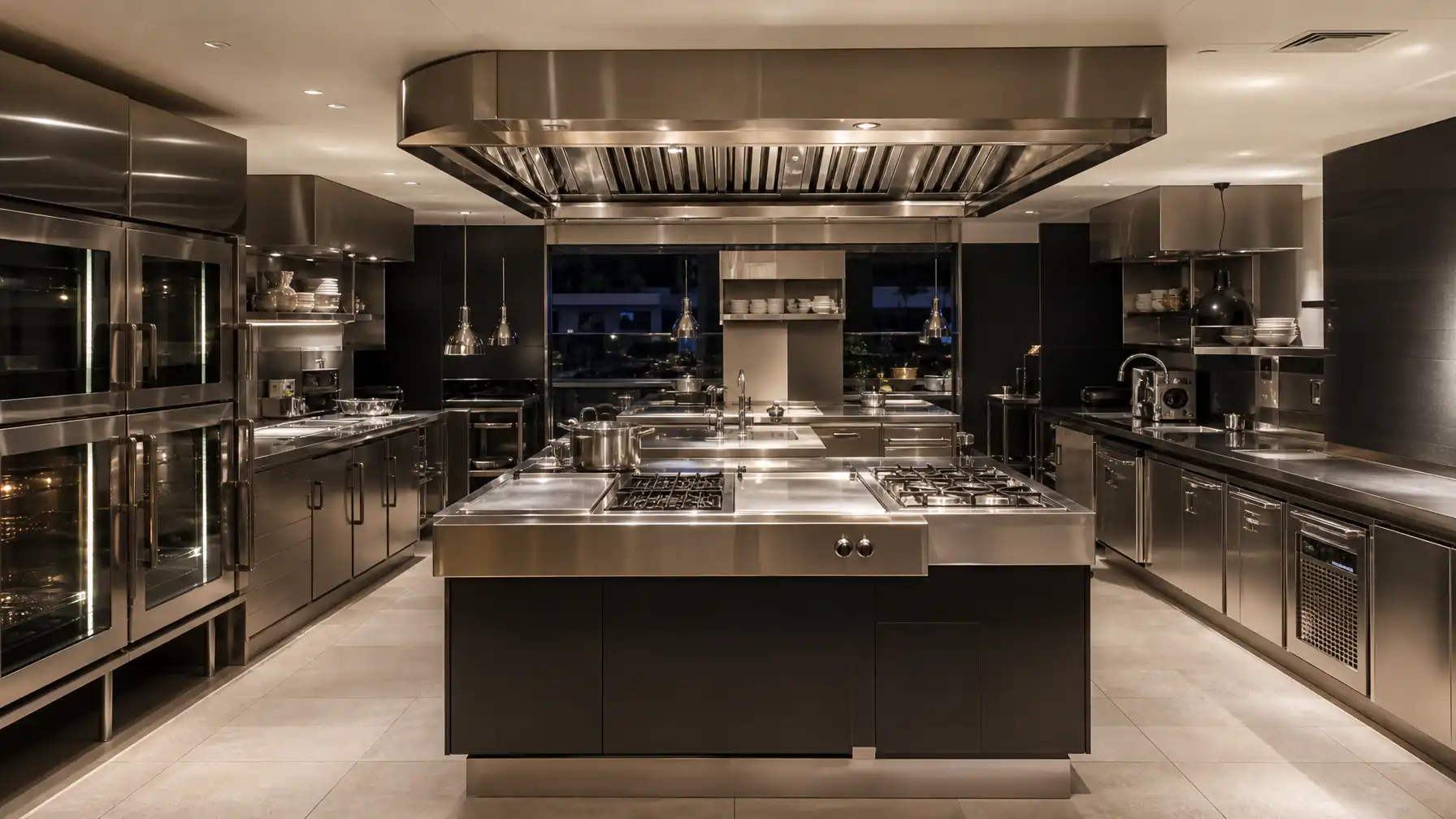
A hotel production kitchen should be zoned by function. Separate zones for cold preparation, hot cooking, pastry and bakery production, and dishwashing allow teams to work simultaneously without interfering with each other. In larger hotels, these zones may each be the size of a standalone restaurant kitchen.
The HACCP principle of separating raw and ready-to-eat food handling must be applied throughout. In a hotel production kitchen, this is particularly important because the volume of raw protein handling, including breakfast meat preparation, banqueting pre-prep, and room service, creates significant cross-contamination risk if the layout does not enforce physical separation.
Stainless Steel Infrastructure
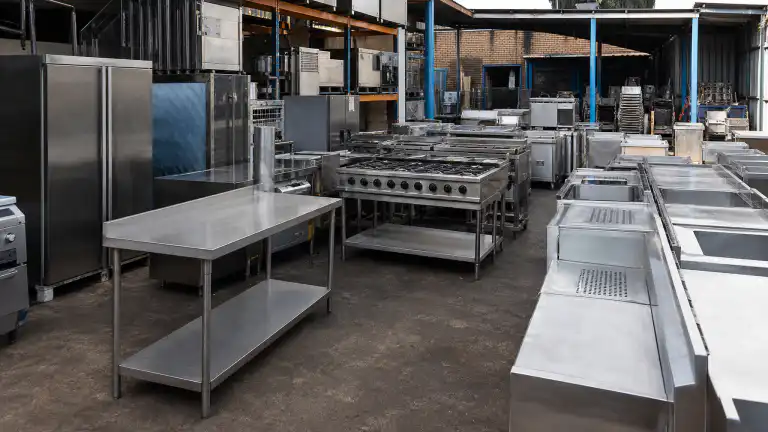
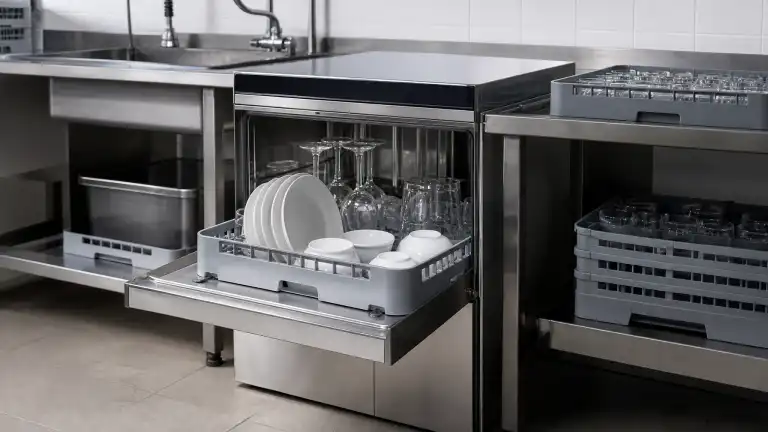
The work surfaces, shelving, and fabricated elements of the production kitchen must be commercial-grade stainless steel throughout. Stainless steel work tables should be specified at the correct height for the work performed at each station, with under-shelf storage where appropriate. Sinks for equipment washing must be positioned to serve each zone without requiring staff to carry dirty equipment through clean production areas. Stainless steel sinks with appropriate drainage and non-touch controls are the standard for food safety compliance.
Ventilation at Scale
Hotel production kitchens generate significantly more heat and cooking vapour than restaurant kitchens. The ventilation system must be specified by a mechanical engineer in conjunction with the kitchen designer, and must account for the combined cooking load of all equipment operating simultaneously at peak service. In South Africa, ventilation specifications must also comply with local fire codes and SANS standards for commercial kitchen extraction.
Step 3: Volume Cooking Equipment
Combination Ovens
Combination ovens (combi ovens) are the most versatile piece of large-volume cooking equipment available. They handle roasting, steaming, and combination cooking modes, and can process multiple trays simultaneously, making them ideal for banqueting and breakfast production. For a hotel of any significant size, multiple combi ovens are typically required, and their placement in the kitchen layout determines the efficiency of the cooking workflow.
Tilt Bratt Pans and Large-Batch Equipment
Breakfast production for 200+ covers, banqueting sauces, and bulk soups require large-batch equipment that most restaurant kitchens do not need. Tilt bratt pans allow large quantities of food to be cooked and dispensed efficiently. Specifying the correct capacity for these items requires a clear projection of peak volumes, typically derived from the hotel's maximum occupancy and anticipated banqueting load.
Step 4: Cold Chain at Scale
Cold chain management in a hotel is more complex than in a restaurant because product moves through more stages, from receiving to cold storage to pre-prep refrigeration to production kitchen to holding to service point. Each transfer is a temperature risk. The equipment specification must include adequate refrigeration at every stage.
Receiving areas should include a dedicated refrigerated holding zone for incoming deliveries before they are checked and moved to main storage. Main cold rooms should be sized with adequate buffer to handle full delivery days at peak occupancy. Walk-in blast chillers are strongly recommended for operations producing large volumes of hot food that must be cooled quickly for safe storage and subsequent regeneration.
Step 5: Compliance at Scale
The South African regulatory framework for hotel kitchens applies the same base requirements as any food premises, but the scale of operation intensifies both the risk and the inspection scrutiny. The TGCSA grading process includes kitchen hygiene assessments, and hotels with poor kitchen hygiene scores risk their grading status.
HACCP implementation is effectively mandatory for hotel food operations, particularly those serving large banqueting functions or supplying room service to guests who may be in vulnerable health categories. The HACCP plan for a hotel kitchen must address each service point individually, as the critical control points differ between a high-volume banqueting production line and a room service finishing operation.
Consulting expertise at the planning stage makes compliance at scale significantly more manageable. The Cater-Ring's consulting service includes compliance guidance as a core component of every hospitality kitchen project.
Step 6: The Cost of Getting It Wrong
In a hotel context, kitchen underperformance has direct financial consequences that compound quickly. Guest complaints about food quality or room service delays generate negative reviews on platforms that influence booking decisions. A kitchen that cannot sustain full-occupancy service forces operators to limit food offerings, which reduces revenue and guest satisfaction simultaneously. A compliance failure that results in a temporary closure during peak season is potentially catastrophic.
The investment in correct planning, including professional consulting, quality equipment specification, and thorough compliance preparation, is invariably less than the cost of a poorly executed kitchen that must be retrofitted or that underperforms over its operational life.
Frequently Asked Questions
How much kitchen space does a hotel need relative to its dining capacity?
A general industry benchmark is one square metre of kitchen space for every three to five covers in the dining room, but this is a starting point only. Hotel kitchens must also account for banqueting load, room service infrastructure, and staff canteen requirements, all of which add significantly to the total kitchen footprint required. The correct calculation is based on total meal production volume across all service points, not dining room covers alone.
What is the difference between a production kitchen and a satellite kitchen in a hotel?
A production kitchen is the primary kitchen where the majority of food preparation and bulk cooking takes place. A satellite kitchen is a smaller finishing or service kitchen located close to a specific service point, such as the banqueting room or pool deck, where food produced in the main kitchen is finished, plated, and dispatched. Satellite kitchens typically require finishing equipment, holding equipment, and plating infrastructure rather than full production capacity.
What compliance standards apply to hotel kitchens in South Africa?
Hotel kitchens must comply with the Foodstuffs, Cosmetics and Disinfectants Act (Act 54 of 1972), the Regulations Governing General Hygiene Requirements for Food Premises (R638), and sector-specific HACCP requirements under SANS 10330. They are also subject to TGCSA grading criteria and local municipal Certificate of Acceptability requirements. Fire code compliance, occupational health and safety requirements, and building regulations also apply.
How should load-shedding affect the specification of a hotel kitchen?
Load-shedding is a material operational risk for hotel kitchens, where refrigeration failure, cooking interruption, or hot-holding equipment failure can compromise food safety and guest service simultaneously. A well-specified hotel kitchen in South Africa will include generator backup for critical refrigeration, and may specify gas cooking equipment or dual-fuel options to maintain cooking capacity during power outages. Equipment selection should account for start-up loads and the sequence in which equipment comes back online after a power restoration.