Every food service operation that prepares food in advance and holds it for service needs reliable hot holding equipment. Whether you manage a hotel buffet, a hospital kitchen, a school canteen, or an event catering operation, the gap between production and service is where food quality deteriorates and food safety risk increases — unless you have the right equipment working correctly.
Bain maries and hot food holding units solve this problem. This guide covers how they work, the configurations available to South African food service operators, what food safety regulations require, and how to select the right setup for your service model.
What Is a Bain Marie and How Does It Work
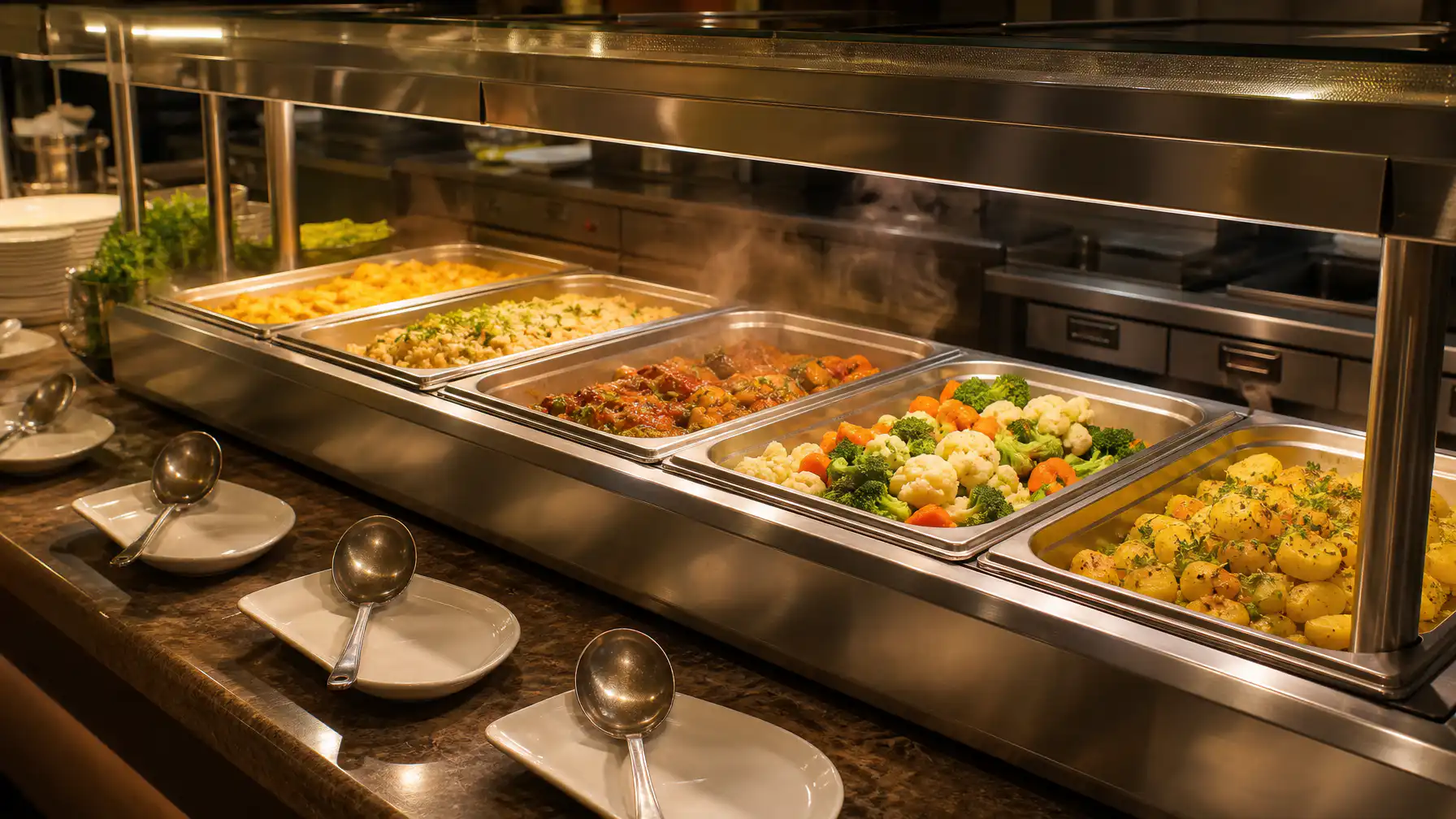
A bain marie is a piece of food holding equipment that keeps pre-cooked food at a safe service temperature without continuing to cook it. The term comes from the French for “water bath,” which describes the original operating principle: a water-filled outer vessel conducts heat gently and evenly into the inner vessel containing the food.
In commercial kitchens, the term now covers a broader range of hot holding equipment. A bain marie may hold food via water bath (wet heat), steam, or direct dry heat. What all configurations share is the purpose: maintain food at or above the required safe service temperature from the end of cooking to the moment of service.
Wet Bain Marie
Wet bain maries heat water in a tank or basin, and gastronorm pans of food sit in or above this heated water. The water creates a humid, consistent heat environment that works particularly well for saucy dishes, soups, gravies, and any food that benefits from moisture retention during holding. Wet bain maries are the standard choice for hotel buffet setups, banqueting service lines, and institutional catering operations across South Africa.
Dry Heat Hot Holding
Dry heat holding equipment uses radiant or convected heat rather than water to maintain food temperature. This suits foods where moisture is undesirable — crispy fried items, baked goods, roasted meats, and portioned proteins that need to hold without steaming. Dry heat holding is common in fast food environments, grab-and-go counters, and display situations where visual presentation of the food is part of the service proposition.
Gastronorm Containers and Sizing
Gastronorm (GN) sizing is the international standard for food service containers, trays, and equipment. All professional bain maries and hot holding units are designed around gastronorm dimensions. Understanding this system is fundamental to specifying equipment that works together as a coherent service setup.
The full gastronorm (GN 1/1) measures 530mm x 325mm. From this base, the range divides into fractions: 1/2, 1/3, 1/4, 1/6, and 1/9. A single full-size bain marie may hold one GN 1/1, two GN 1/2s, or three GN 1/3s — giving you flexibility in how you organise and subdivide your service line. Standard depths range from 65mm to 200mm, and the depth you choose affects portion volume and the type of food being held.
When specifying a bain marie, confirm the number and fraction size of GN positions the unit holds. A 4 x GN 1/3 countertop unit suits most restaurant applications. A 3 x GN 1/1 floor-standing unit suits high-volume hotel or institutional service. The Cater-Ring stocks a comprehensive range of food preparation equipment including GN containers, heavy-duty inserts, and accessories in all standard fractions and depths.
Food Safety and Temperature Requirements in South Africa
South African food safety practice aligns with international standards on hot holding temperature. Hot food must be maintained at 63°C or above during holding and service. This minimum temperature inhibits the growth of pathogenic bacteria in the temperature danger zone (5°C–60°C), where bacteria multiply most rapidly.
In practice, the requirement is clear: your hot holding equipment must reach and maintain at least 63°C at the food surface, not only at the element or water. Regular temperature monitoring using a calibrated probe thermometer is required during service. Food that drops below the minimum holding temperature and cannot be safely reheated to 75°C should be discarded, not held further.
A critical distinction that is often misunderstood: bain maries are for hot holding only. They are not designed to cook food or to reheat food from cold. Food must arrive in the bain marie already cooked and at the correct internal temperature. Using a bain marie to bring cold or lukewarm food up to temperature is a food safety breach and is typically insufficient to eliminate bacterial loads that may have developed during improper storage.
Countertop vs Floor-Standing Configurations
Countertop Bain Maries
Countertop units are compact and flexible. They sit on a work surface and are available in wet and dry heat configurations. A typical countertop unit holds 3–6 GN 1/3 pans and suits restaurants, cafés, smaller hotels, and any operation with limited floor space or variable service layouts. They are simpler to set up and reposition than floor-standing units and work well on stainless steel kitchen tables, which provide the correct surface height and hygienic work environment for food holding equipment.
Floor-Standing Bain Maries
Floor-standing units hold larger food volumes and are self-supporting structures. They typically include under-counter storage or an enclosed cupboard below the holding deck. They suit high-volume service operations including hotel buffets, banqueting facilities, hospital or university catering, and contract food service. Available with castors for mobility in large kitchens and event spaces where service layout changes between functions.
Built-In vs Drop-In Configurations
For operators fitting out a custom service counter or buffet line, the choice between built-in and drop-in bain maries affects both the finished aesthetic and the installation process.
Drop-In Bain Maries
Drop-in units are cut into the surface of a counter, with the holding well sitting flush or slightly raised in the cutout. The unit is sealed around the perimeter and connected to power. Drop-in configurations produce a clean, integrated look for hotel buffet serveries, corporate dining facilities, and any environment where presentation standards are high. They require precise counter dimensions and a qualified installer to achieve a watertight, food-safe result.
Built-In Bain Maries
Built-in units are integrated into a complete counter module purchased as a single piece. Common in modular food service counter systems, they are simpler to specify and install because the countertop and the bain marie are already matched and assembled. Less flexible in terms of layout customisation, but a practical and cost-effective choice for straightforward service counter setups where speed of installation matters.
Applications Across South African Food Service Operations
Hotel and Banqueting Service
Hotels across South Africa’s hospitality corridor use bain maries as the primary hot holding solution for breakfast and dinner buffets, conference catering, and wedding banqueting. Floor-standing models with 3–5 GN 1/1 positions are standard in hotel production kitchens. For banqueting operations moving food between kitchen and event venue, insulated holding and distribution equipment supports the bain marie holding system and extends the food safety chain through transport.
Institutional and Contract Catering
Hospitals, schools, universities, and corporate canteens throughout South Africa manage large daily volumes under tight service windows and rigorous food safety oversight. Bain maries in institutional settings need to be robust, easy to clean, consistently accurate in temperature, and capable of handling multiple daily service periods. Full stainless steel construction and thermostatically controlled elements are the standard specification at this level.
Food Transport and Off-Site Catering
Catering operations transporting hot food to events or corporate clients use insulated bain marie transport units or bain marie trolleys. These maintain temperature during transit without an external power source and are a critical part of the food safety chain for off-site service. Without purpose-built transport holding equipment, hot food inevitably enters the danger zone during the journey from kitchen to serving location.
Bakeries, Butcheries, and Food Retail
Bakeries and butcheries offering prepared hot food, as well as food retail counters selling cooked products, rely on bain marie or dry heat holding units to maintain product at legal service temperatures throughout the retail day. South African food retail and takeaway operations are required to maintain hot food display temperatures in line with food safety standards, and the equipment must be calibrated to meet this consistently.
Energy Efficiency Considerations
Bain maries running for 4–8 hours per service period represent a meaningful ongoing energy cost for any food service operation. Thermostatically controlled units that maintain a set temperature rather than running at maximum output are significantly more efficient than older models without effective temperature regulation. Look for well-insulated water tanks on wet models, quality thermostats, and elements sized to the unit’s capacity rather than oversized for maximum heat output.
For operations planning a complete kitchen setup that includes hot holding equipment, The Cater-Ring’s consulting services team can assist with specifying the right combination of equipment for your service model, kitchen layout, and energy constraints. We supply commercial catering equipment across South Africa and can advise on lead times, installation requirements, and ongoing support.
Matching Bain Marie Specification to Your Service Model
The right bain marie for a 40-seat restaurant serving a three-course set menu is not the same unit as the right choice for a hotel serving 300 buffet covers at breakfast. Correct specification requires you to know your peak service volume, the food types you will hold, your available counter space or floor area, and whether your service is stationary or mobile.
Key specification questions before purchase:
- How many GN positions do you need, and in which fractions?
- Do you need wet heat, dry heat, or a combination?
- Is the unit for fixed counter installation or mobile use?
- What is your available power supply (single phase vs three phase)?
- Does the unit need to meet a specific height or depth for drop-in counter integration?
Getting these answers right before ordering eliminates the common problem of purchasing a unit that technically works but does not fit the service layout or volume requirement in practice.
Frequently Asked Questions
What temperature must hot food be held at in South Africa?
Hot food must be held at 63°C or above. This is the internationally recognised minimum temperature for hot holding and aligns with South African food safety practice. Food held below this temperature enters the bacterial danger zone and presents a contamination risk that cannot be mitigated without full reheating to a safe core temperature.
Can a bain marie be used to cook or reheat food?
No. A bain marie maintains temperature only. It should never be used to cook raw food or to bring cold food up to temperature. Food must be fully cooked and at a safe core temperature before being placed in the bain marie for service holding. Using it for reheating is a food safety breach and an equipment misuse that also damages the unit over time.
What is the difference between a wet bain marie and dry heat holding?
A wet bain marie uses heated water to transfer heat to food containers, creating a moist holding environment suited to saucy, liquid-rich, or high-moisture dishes. Dry heat holding uses radiant or convected heat without water, making it better suited for crispy, portioned, or baked items where moisture would compromise texture and presentation quality.
How do I know which gastronorm size my bain marie uses?
All commercial bain maries are specified in GN terms. The product specification states the number and fraction of GN positions the unit holds — for example, 3 x GN 1/3 or 2 x GN 1/1. Match this to the GN containers you plan to use in service. The Cater-Ring’s food preparation range includes GN inserts in all standard fractions and depths to complete your setup.
How long can food safely be held in a bain marie?
Food held consistently above 63°C can be held for the duration of a service period, but quality degrades over time regardless of temperature maintenance. Most professional kitchen standards recommend a maximum holding window of 2–4 hours for most food types before quality becomes unacceptable. After this period, discard and replace with freshly produced product. Extended holding beyond 4 hours is particularly damaging to texture and moisture content in most proteins and cooked vegetables.