Running a successful commercial bakery operation in South Africa requires more than great recipes. The equipment behind the bench determines your production capacity, consistency, energy costs, and the quality customers experience in every product you sell.
Whether you are setting up a new bakery, scaling an existing operation, or upgrading equipment that has reached its limit, this guide covers the ten pieces of bakery equipment that form the operational foundation of any South African commercial bakery.
1. Commercial Dough Mixers
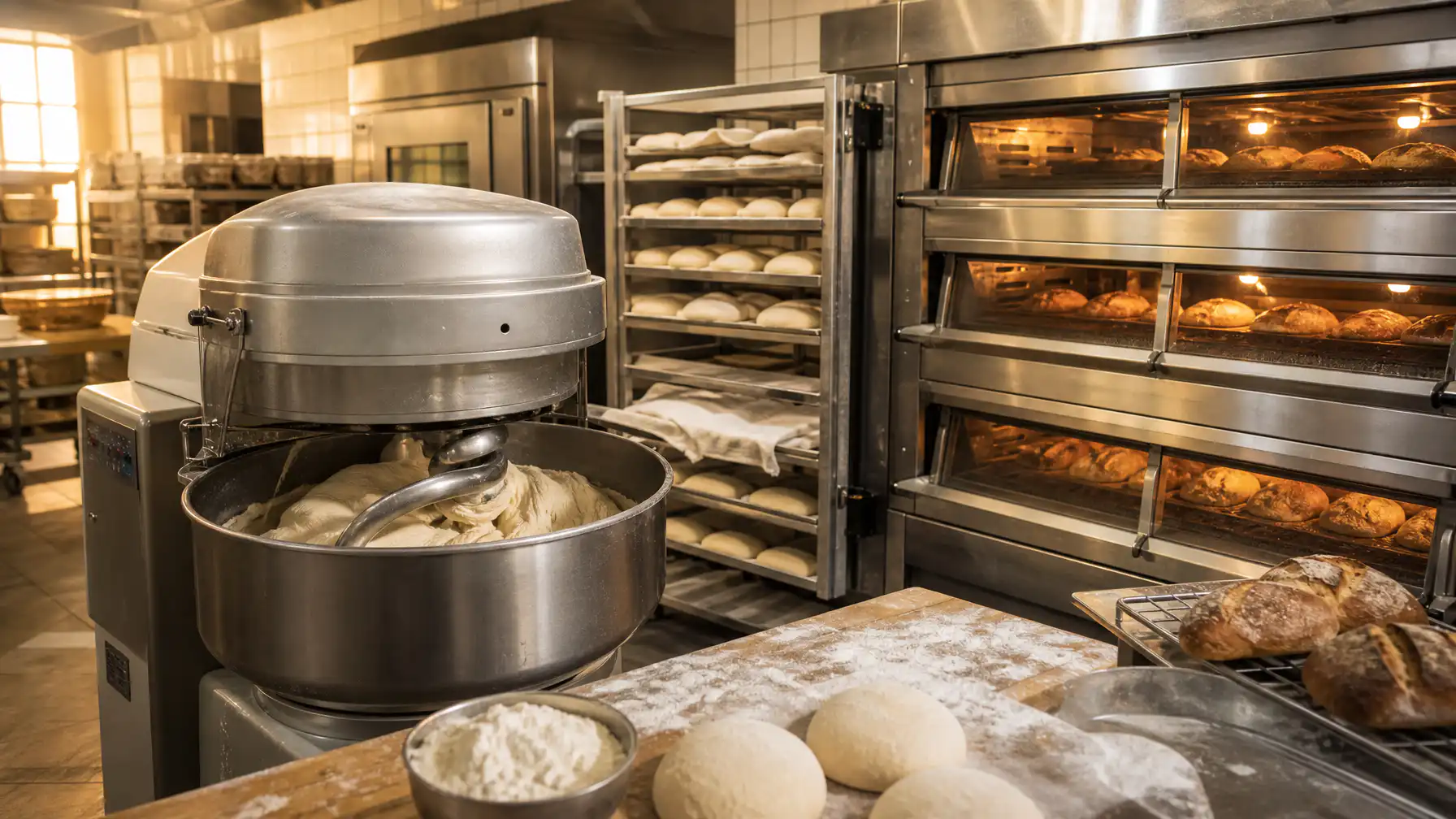
The dough mixer is the single most important piece of equipment in a commercial bakery. Every bread loaf, pastry, biscuit, and cake batter begins here. A commercial mixer with adequate bowl capacity and motor power for your production volume ensures consistent dough development, the foundation of consistent texture, crumb, and flavour across every batch.
Commercial dough mixers are available in spiral and planetary configurations:
- Spiral mixers are designed specifically for bread dough and generate less heat during mixing, preserving dough quality over long production runs
- Planetary mixers are more versatile, handling doughs, batters, whipped ingredients, and fillings across a broader product range
Selecting the right type and capacity for your production volume is one of the most consequential equipment decisions a bakery makes. Under-speccing a mixer creates a bottleneck that limits your entire operation; over-speccing creates unnecessary capital and energy cost.
2. Deck Ovens
Deck ovens are the defining piece of equipment for artisan bread and high-quality pastry production. The stone or steel deck surface absorbs and radiates heat directly into the base of the loaf, producing the characteristic thick crust and open crumb structure that characterises professional bread.
Key advantages of deck ovens for South African commercial bakeries:
- Direct heat transfer from the deck surface drives crust development that convection ovens cannot replicate
- Independent deck temperature control allows different products to bake simultaneously at optimal temperatures
- Steam injection capability (on equipped models) creates the humid baking environment required for professional sourdough, baguettes, and rye breads
- Multi-deck configurations allow high-volume production without a proportionally large footprint
3. Convection Ovens
Convection ovens use fan-circulated air to bake more evenly and efficiently than static ovens. They are the workhorse of most South African commercial bakeries, handling cookies, cakes, muffins, croissants, savoury pastries, and any product that benefits from even, consistent heat across the entire oven cavity.
A convection oven reduces baking time by 20-30% compared to a conventional static oven at the same temperature, directly reducing energy costs per batch. For high-volume bakeries turning over multiple bakes per day, this efficiency gain is commercially significant.
4. Proofing Cabinets
Proofing cabinets provide the controlled temperature and humidity environment that yeast-leavened doughs require to rise properly before baking. Without controlled proofing, dough rise is inconsistent, too fast in summer, too slow in winter, producing variable results across seasons and times of day.
A commercial proofing cabinet eliminates this variability. Your team can mix dough on a predictable schedule, load the proofer, and pull ready-to-bake product at the planned time regardless of ambient conditions. This control is one of the most direct contributors to bakery output consistency.
South African bakeries operating in variable climates, particularly in inland areas with significant summer/winter temperature swings, benefit most directly from the consistency that a controlled proofing environment delivers.
5. Dough Sheeters
For bakeries producing pastries, croissants, puff pastry, and laminated dough products, a dough sheeter reduces what would be hours of physical rolling into minutes of consistent, uniform output. A sheeter rolls dough to an exact, programmable thickness across the full sheet width, producing the even lamination layers that define the quality of croissants and Danish pastries.
Manual rolling of laminated dough at commercial volumes is physically demanding and produces inconsistent results. A commercial sheeter standardises quality and frees your team to focus on other production tasks.
6. Bread Slicers
For bakeries supplying sliced loaves to retail, hospitality, or food service customers, a commercial bread slicer is essential. Bread slicers produce uniform slices at commercial speed, ensuring consistent presentation for retail packaging and eliminating the waste of irregular manual slicing.
Customers purchasing sliced bread from a professional bakery expect uniform slices of consistent thickness. A bread slicer delivers this at a pace that hand slicing cannot match at commercial volume.
7. Dough Dividers
Commercial dough dividers portion a batch of dough into equal units by weight, ensuring every loaf, roll, or bun starts at the same size. This is critical for consistent bake time, uniform product presentation, and accurate pricing, all items sold by weight or as individual units need to be within acceptable tolerances.
A dough divider also significantly accelerates the portioning step in your production workflow, removing one of the most time-consuming manual tasks in high-volume bread production.
8. Commercial Refrigeration for Bakeries
Refrigeration in a bakery serves two distinct functions: ingredient storage and dough retardation.
Ingredient storage, dairy, eggs, fats, fillings, and fresh fruit, requires standard commercial refrigeration with reliable temperature maintenance and adequate capacity for your production volume.
Dough retardation, placing portioned dough in the refrigerator to slow fermentation overnight, is a technique used in professional bakeries to develop complex flavour and allow flexible production scheduling. A retarder-prover (a unit that can move between refrigeration and proofing modes on a programmable cycle) automates this process and allows very early baking without overnight staff presence.
9. Stainless Steel Work Surfaces
Stainless steel work tables sized and positioned for your production flow are the structural backbone of bakery efficiency. Adequate surface area at the right heights allows your team to move through the production sequence without crowding or waiting for surface space.
In a bakery, the work surface adjacent to the mixer is used for scaling, the surface beside the sheeter is used for laminating and cutting, and the surface near the oven is used for shaping, loading, and cooling. Each of these positions needs enough space for the task to be completed without staff interfering with each other.
10. Display Cases
Display cases are the final piece of the bakery production chain, the point where product is presented to customers. A well-configured display case keeps baked goods at the right temperature (ambient or chilled depending on product), maintains visual appeal, and actively sells product at the point of purchase.
For patisserie, cakes, and filled pastries, refrigerated display cases maintain product safety and texture. For bread, savouries, and ambient pastries, ambient display cases at the right height and with appropriate lighting maximise visibility and impulse purchase rate.
Bakery Equipment Selection: Key Considerations for South African Operations
| Factor | What to Evaluate |
|---|---|
| Production volume | Match mixer bowl size, oven capacity, and proofer capacity to your daily output target |
| Product range | Deck oven for artisan bread; convection oven for pastry; both for a full range |
| Electricity supply | Confirm phase requirements, three-phase power is required for most commercial baking equipment |
| Floor space | Measure equipment footprint against available space before purchasing |
| Growth plans | Spec slightly above current volume to accommodate growth without immediate re-equipment |
Working With The Cater-Ring on Your Bakery Equipment
The Cater-Ring supplies commercial bakery equipment to South African bakeries, hotels, restaurants, culinary schools, and food production facilities. Our team can guide you through specification, matching equipment type and capacity to your specific production requirements and space constraints.
Whether you are equipping a new bakery from scratch or upgrading an ageing mixer or oven, contact the team at +27 10 109 2104 or explore the full range at caterring.co.za/product-category/bakery-equipment/.
Frequently Asked Questions
What is the difference between a spiral mixer and a planetary mixer for bakeries?
A spiral mixer is optimised for bread dough. Its spiral hook and rotating bowl develop gluten structure efficiently with minimal heat generation, preserving dough temperature during long mixing cycles. A planetary mixer has a rotating attachment and stationary bowl, making it more versatile for batters, creams, meringues, and lighter doughs. Most commercial bakeries benefit from having both if their product range spans bread and pastry.
How many decks does a South African commercial bakery need?
The number of decks depends on production volume and product type. A small artisan bakery can operate effectively with a single two-deck oven. A high-volume bread production facility may require three or more decks to maintain output. The Cater-Ring team can advise on the right configuration for your intended daily output.
What electrical supply is required for commercial bakery equipment in South Africa?
Most commercial baking equipment, deck ovens, convection ovens, commercial mixers, requires three-phase electrical supply (380V in South Africa). Confirm your premises have the required supply and appropriate circuit capacity before purchasing commercial bakery equipment.
Does The Cater-Ring supply bakery equipment to smaller artisan bakeries as well as large operations?
Yes. The Cater-Ring supplies bakery equipment to operations across all scales, from single-person artisan bakeries to large-scale production facilities. Equipment recommendations are matched to your specific production volume and product range. Contact the team at +27 10 109 2104 to discuss your requirements.