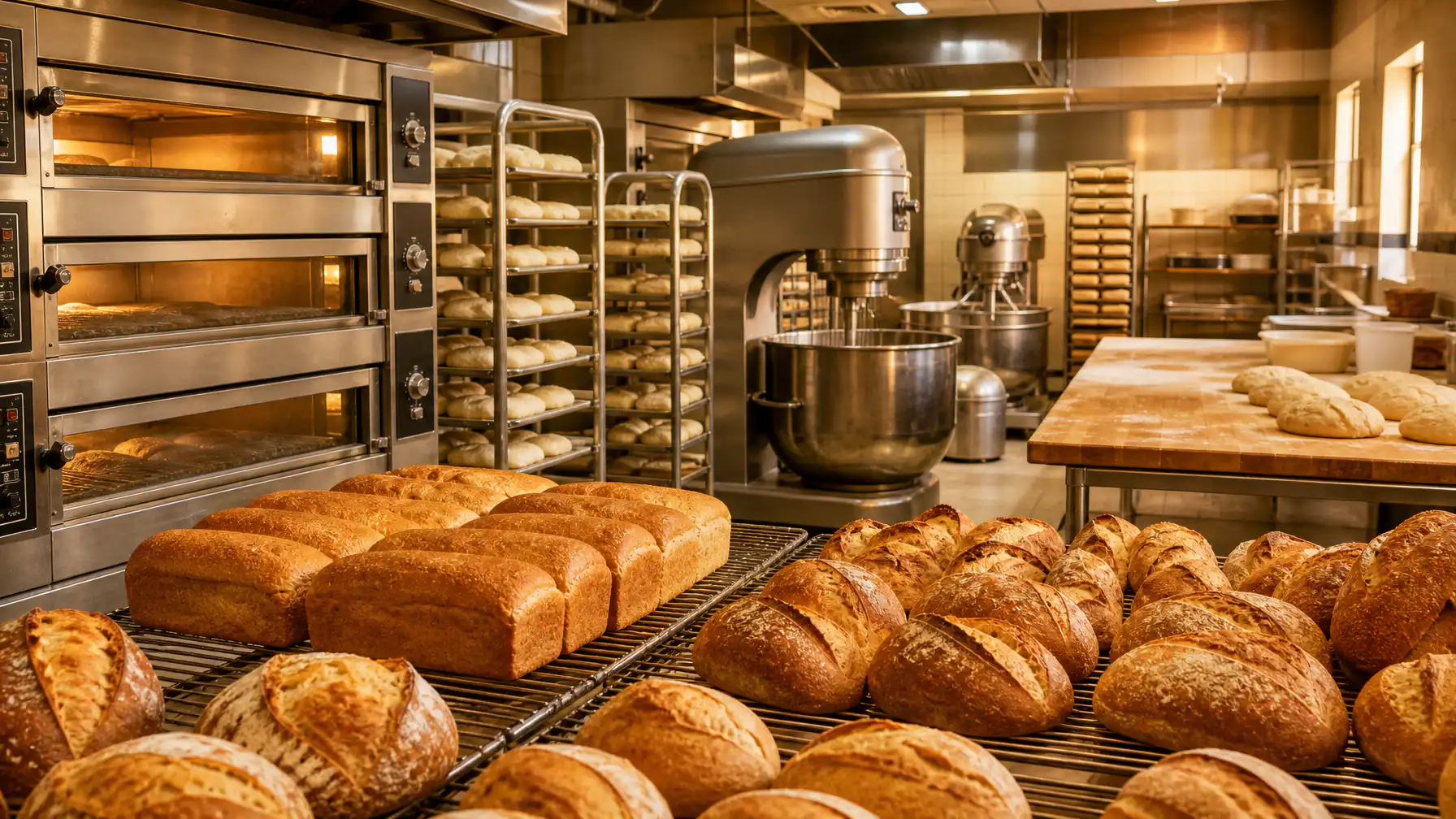
South Africa's bakery and cereals market is substantial and growing. Bread remains a staple across income groups, and the premium end of the market, including artisan loaves, pastries, croissants, and specialty confectionery, is expanding consistently in urban areas. A well-specified commercial bakery built around the right equipment and the right production workflow is a viable and often highly profitable business.
The challenge is that commercial bakery setup is a sequence of interdependent decisions. The size of your mixer determines your batch output. Your batch output determines your proofing and oven capacity requirements. Your oven capacity determines your cooling, packing, and display infrastructure. Get the sequencing wrong, and you build a production line with a bottleneck at every stage.
This guide takes you through the full equipment sequence, the compliance obligations you need to meet, and the production workflow logic that makes a commercial bakery profitable from the first week of trading.
Understanding the South African Bakery Market
Commercial bakeries in South Africa fall into three broad categories. Plant bakeries, such as Albany and Sasko, operate at industrial scale with highly automated production lines. Retail bakeries operate within larger supermarkets and food retail outlets, producing fresh bread and pastries daily for in-store sale. And independent commercial bakeries, which represent the most common entry point for new operators, supply wholesale to delis, restaurants, hotels, schools, and individual customers.
The independent commercial bakery occupies a market position that the large plant bakeries cannot serve effectively, particularly for artisan, specialty, and small-batch products. This is where quality, consistency, and product differentiation drive customer loyalty and margin.
Phase 1: Production Workflow Design
Before selecting any equipment, define your production workflow. The standard commercial bakery workflow runs as follows:
Ingredient receiving and storage → Scaling and mixing → First fermentation → Dividing and shaping → Proofing → Baking → Cooling → Slicing or finishing → Display, packaging, or dispatch
Each stage requires dedicated equipment and adequate space. The layout of your bakery must allow product to move forward through this sequence without backtracking, which creates bottlenecks and cross-contamination risk.
The key principle in bakery layout design is the separation of raw dough handling areas from finished product areas. Raw ingredients and dough carry flour dust and yeast, which can contaminate finished products. This is both a quality issue and a food safety issue, particularly for allergen management, which is increasingly scrutinised by customers and inspectors alike.
Phase 2: Mixing Equipment
The mixer is the engine of the bakery. Your mixer capacity in litres determines your maximum batch size, which in turn determines everything downstream.
Spiral Mixer vs Planetary Mixer
This is the first major equipment decision in a commercial bakery, and the answer depends on your product range.
A spiral mixer is designed specifically for bread doughs. It develops gluten more gently than a planetary mixer, produces a better crumb structure in artisan breads, and handles high-hydration doughs effectively. If your primary product is bread, loaves, rolls, or similar yeasted products, a spiral mixer is the better choice.
A planetary mixer is a more versatile piece of equipment. It handles bread doughs, pastry, cake batter, and whipped products, making it suitable for bakeries with a broader product range including cakes, biscuits, and confectionery. For a mixed product bakery, a planetary mixer is often the more practical investment, potentially supplemented with a spiral mixer as the operation grows.
Commercial mixer capacities in South Africa commonly range from 20 litres, suitable for very small bakeries or test kitchens, up to 80 litres and above for higher-volume production. Specify your mixer capacity based on your projected daily production volume, accounting for realistic batch cycle times and the number of production runs you can complete in a day. You can browse the full range of bakery equipment available from The Cater-Ring, including mixers suited to different production scales.
Phase 3: Proofing
Proofing, or fermentation after shaping, is the stage that most affects the quality of the final baked product. Temperature and humidity control during proofing determines the rise, texture, and flavour of the bread.
Proofer Sizing
A commercial proofer should be sized to hold the output of at least one full mixer batch, plus the previous batch if you are running continuous production. Running production where the proofer is always the limiting factor, forcing bakers to wait for space before they can load shaped dough, is a common and costly inefficiency in undercapitalised bakeries.
In South Africa, ambient temperature variation is a real consideration for proofer specification. A bakery operating in Cape Town in winter faces very different ambient conditions from one in Durban in summer. A temperature-controlled proofer ensures consistent results regardless of the season and climate, which is important for product consistency and for protecting the predictability of your production schedule.
Retarder-Proofers
For bakeries that want to manage overnight production schedules or stagger their baking times, a retarder-proofer is a valuable investment. It slows the proofing process overnight at low temperature, then automatically warms the product to proof temperature ahead of the morning bake. This allows a single shift to produce morning-fresh products without requiring a pre-dawn start time, which has significant staffing implications.
Phase 4: Baking Equipment
Deck Oven vs Convection Oven
This is the central equipment decision of the bakery. Both oven types have a legitimate place in a commercial bakery, but they are not interchangeable.
A deck oven bakes by radiant heat from above and below, with direct contact between the dough and the stone or steel deck. This produces the characteristic crust and crumb structure of artisan bread, sourdough, and European-style loaves. If artisan bread is your primary product, a deck oven is the correct specification. Deck ovens are available in configurations from two to six decks, with each deck independently temperature-controlled.
A convection oven circulates hot air around the product, producing even browning and faster bake times. It is better suited to pastries, biscuits, croissants, rolls, and confectionery items where even colouring and faster throughput matter more than crust character. For a diversified product bakery, a convection oven often complements a deck oven rather than replacing it.
For South African bakeries concerned about load-shedding, gas deck ovens are a meaningful consideration. They continue operating during power outages, protecting both the production schedule and the product already in proof. The trade-off is that gas connections require appropriate infrastructure and compliance with local authority requirements for gas installations.
Phase 5: Dough Processing Equipment
A dough sheeter is essential for any bakery producing croissants, puff pastry, Danish pastry, pizza bases, or similar laminated or rolled products. It produces consistent thickness across large volumes of dough, which manual rolling cannot replicate at commercial scale. A dough sheeter also significantly reduces labour time and physical strain on bakery staff.
A dough divider ensures consistent portion sizes, which is important both for product consistency and for cost control. Manual portioning introduces variation in piece weight, which translates directly to variation in baking time, product quality, and food cost per unit.
Phase 6: Cooling, Display, and Packaging
Cooling Infrastructure
Bread removed from the oven too hot and packed immediately traps steam, produces a soft soggy crust, and has a shortened shelf life. Adequate cooling rack capacity is essential. A commercial bakery producing continuous batches must have enough rack space to hold finished product while it cools to the correct temperature, without creating a traffic bottleneck in the production area.
Display Refrigeration
For bakeries with a retail counter, display refrigeration for finished products is a revenue driver. Refrigerated display cases for pastries, cream-filled products, and artisan loaves allow product to be presented well and maintained at safe temperatures throughout the sales period. Temperature-controlled display is required under food safety regulations for products containing cream, custard, or other high-risk fillings.
Packaging
Packaging requirements range from simple paper bags and box packaging for retail sale to heat-sealed plastic bags for wholesale distribution. If you supply product to retailers or food service operators with shelf-life requirements, vacuum packing or modified atmosphere packaging may be required. Specify your packaging equipment based on your distribution channels, not just your immediate retail operation.
Phase 7: Compliance and Licensing
South African commercial bakeries require a Certificate of Acceptability from the local municipality's Environmental Health Practitioner before commencing operations. Commercial bakeries supplying retail or food service customers are typically subject to more comprehensive inspections than home-based operations, covering premises design and construction, equipment hygiene, pest control, cold chain management for products requiring refrigeration, staff hygiene, and waste disposal.
Food labelling requirements under the Regulations Relating to the Labelling and Advertising of Foodstuffs (R146) apply to bakery products sold in packaged form. Labels must include ingredient lists, nutritional information, allergen declarations, and best-before or use-by dates. This is particularly relevant for bakeries supplying supermarkets or food retail outlets.
HACCP implementation, while not formally mandated for all commercial bakeries, is required by most major retail buyers and is strongly advisable for any operation producing product for third-party distribution. The food preparation equipment and workflow design in your bakery should be structured to support HACCP compliance from the outset.
Getting the Specification Right
The commercial bakery equipment decisions described above are interdependent. A mistake in mixer sizing creates a cascade of problems through proofing, oven loading, and production scheduling. Getting professional guidance on the equipment specification before committing capital is the single most effective risk mitigation available to a new bakery operator.
The Cater-Ring supplies the full range of commercial bakery equipment in South Africa, from entry-level setups for new operators through to high-capacity production lines for established businesses. Our consulting service is available to guide bakery projects from initial concept through to equipment specification, compliance preparation, and opening.
Frequently Asked Questions
How much does it cost to set up a commercial bakery in South Africa?
The cost varies significantly depending on the scale of the operation and the product range. A small commercial bakery with a 40-litre spiral mixer, a two-deck oven, a proofer, and basic ancillary equipment can be established for approximately R200,000 to R400,000. A larger operation with spiral and planetary mixers, multiple deck ovens, a retarder-proofer, a dough sheeter, and full display and packaging infrastructure may require R800,000 to R2 million or more. A detailed equipment specification from a consultant will give you an accurate project cost based on your specific requirements.
Do I need planning permission to open a commercial bakery in South Africa?
Yes. Commercial food premises require zoning compliance for the intended use, which must be confirmed with your local municipality before committing to a lease or purchase. You also require a Certificate of Acceptability from the Environmental Health Practitioner, a municipal business licence, and compliance with building regulations for any structural work or alterations to the premises.
What is the difference between a spiral mixer and a planetary mixer for a bakery?
A spiral mixer is optimised for bread doughs. Its spiral hook and rotating bowl develop gluten more gently and efficiently than a planetary mixer, making it better suited to high-hydration artisan doughs. A planetary mixer is more versatile and handles a wider range of products including cakes, pastry, and confectionery. Many commercial bakeries with a broad product range use both.
How should I plan for load-shedding in my bakery equipment specification?
Load-shedding is a significant operational risk for bakeries because oven interruptions mid-bake and proofer temperature fluctuations both affect product quality directly. Gas deck ovens continue operating during power outages and are a popular choice in the South African market for this reason. Critical refrigeration for display cases and chilled products should be backed by a generator or UPS. A consultant can advise on the right contingency approach based on your local Eskom supply reliability and the specific risk profile of your product range.