Deck ovens and convection ovens produce fundamentally different results. A baker who uses the wrong oven for their product range either compromises product quality, wastes energy, or both. If you are setting up a South African commercial bakery or upgrading your production equipment, this comparison gives you the information to make the right oven decision the first time.
How a Deck Oven Works
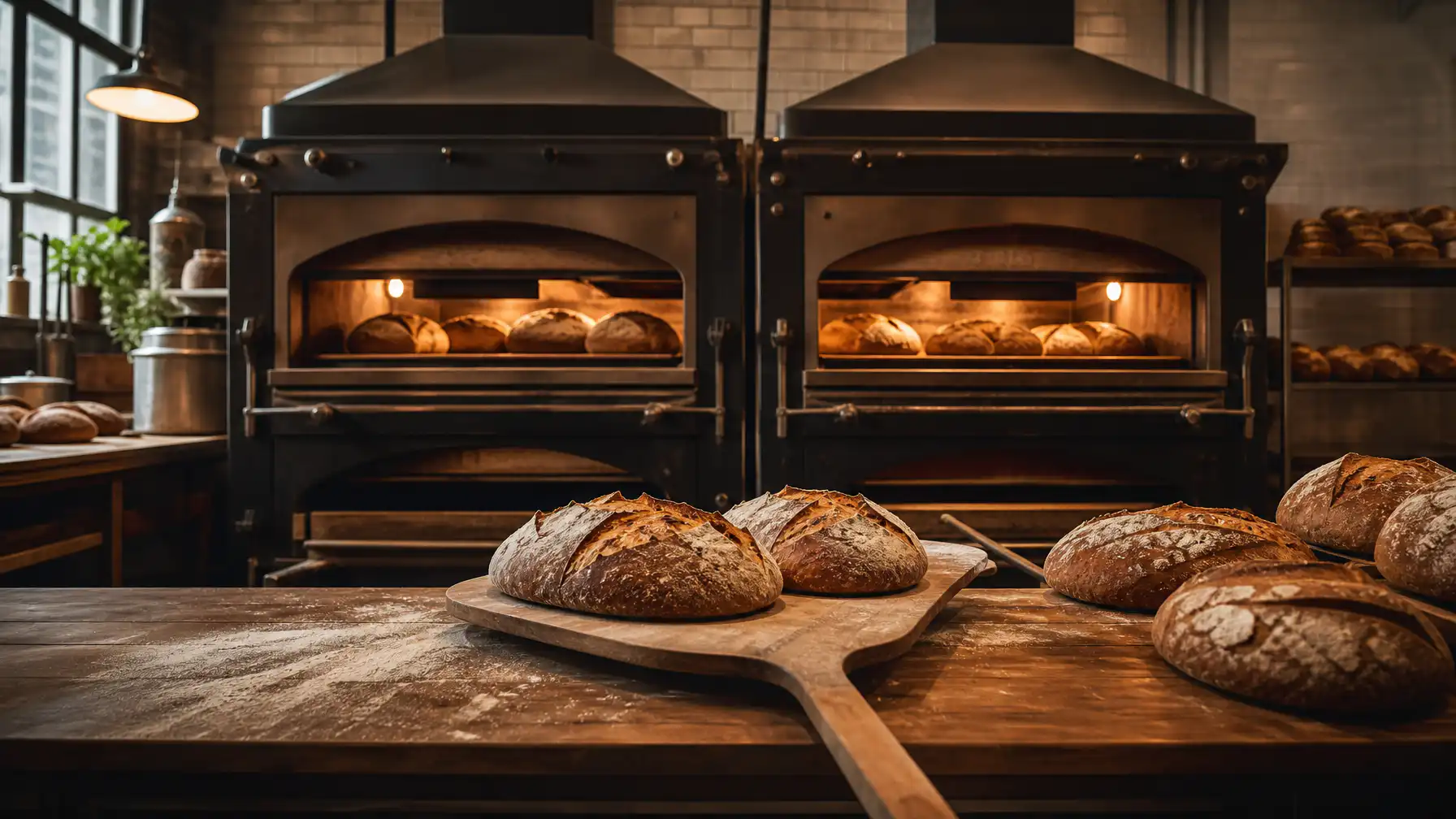
A deck oven heats product from below through a solid stone or steel deck, using radiant heat rather than moving air. The baking surface absorbs and radiates heat directly into the base of the product, creating the characteristic thick, well-set bottom crust that is essential for artisan breads, baguettes, ciabatta, and pizza.
Most commercial deck ovens include a steam injection system. Steam is injected at the start of the baking cycle, which keeps the outer surface of the dough pliable during initial oven spring. This allows the loaf to expand fully before the crust sets, producing the open crumb structure and blistered, glossy crust that defines high-quality artisan bread.
Deck ovens are typically multi-deck, meaning they stack multiple baking chambers vertically. Each deck operates independently with its own top and bottom heat controls. A three-deck oven can run three different products at three different temperatures simultaneously, giving experienced bakers considerable production flexibility in a single unit.
The commercial deck oven range at The Cater-Ring includes models from leading commercial bakery equipment manufacturers suited to South African production environments, from small artisan bakeries to high-volume wholesale operations.
How a Convection Oven Works
A convection oven heats product using a fan that circulates hot air throughout the baking chamber. The moving air eliminates hot spots, distributes heat evenly across all trays, and transfers heat to the product faster than still air. This produces rapid, even baking across large batches.
The fan-driven heat is efficient for products that need to set quickly and uniformly, including pastries, cookies, croissants, muffins, rolls, and cakes. In a convection environment, multiple trays bake to the same result because the circulating air reaches all surfaces equally, which eliminates the tray rotation that is necessary in a static oven.
Convection ovens accept gastronorm trays or standard bakery trays depending on the model. Most South African commercial convection ovens hold 4, 6, or 10 trays per chamber. High-capacity models for wholesale production accommodate significantly more.
The convection oven range at The Cater-Ring covers compact models for smaller operations through to high-capacity units for wholesale and institutional production.
What Each Oven Produces Best
Deck Oven Strengths
The deck oven excels with products that depend on direct base heat and crust development through steam. This includes:
- Sourdough and artisan breads
- Baguettes and French-style loaves
- Ciabatta and focaccia
- Pizza
- Rye breads and dense grain loaves
The defining characteristic is crust quality. Products baked in a deck oven develop a crust that convection cannot replicate: thick on the bottom, thin and blistered on top, with a clear contrast between crust and crumb. This is the direct result of radiant bottom heat from the deck surface combined with steam injection at the start of the bake.
Convection Oven Strengths
The convection oven excels with products where even heat distribution across multiple trays is the priority and a defined crust structure is not required. This includes:
- Croissants, pain au chocolat, and laminated pastries
- Muffins, cupcakes, and individual cakes
- Cookies and biscuits
- Dinner rolls and soft bread rolls
- Pies and tarts
- Meringues and macarons
Convection is also faster than deck baking for these product types, which matters in a high-volume production environment where oven throughput determines daily output capacity.
Energy and Operating Costs
Deck ovens take longer to reach baking temperature and retain heat in their thermal mass, making them less energy-efficient for intermittent use but more efficient during continuous production. A deck oven running through a full production day makes better use of its thermal mass than one switched on for two hours and off again.
Convection ovens heat up faster and recover temperature between loads more quickly. This suits operations that bake in shorter bursts throughout the day, such as a coffee shop or hotel kitchen producing fresh pastries across multiple service periods rather than in a single sustained production run.
In the current South African energy environment, loadshedding and electricity tariffs are real factors in oven selection. Gas deck ovens provide independence from the grid during load shedding, which is a meaningful operational advantage in South Africa’s current electricity context. Electric convection ovens with efficient insulation reduce running costs and offer precise digital temperature control. Both fuel types are worth factoring into the total cost of ownership calculation alongside the purchase price and installation cost.
Space Considerations
Deck ovens have a larger footprint than equivalent-capacity convection units and require more ceiling height due to their stacked-deck design. A three-deck oven can stand 1.8-2.0 metres tall and requires clearance for loading at the top deck. Extraction ventilation is required above any deck oven installation.
Convection ovens are more compact relative to their tray capacity. A six-tray convection oven fits comfortably in a small commercial kitchen or café preparation area. Benchtop convection models exist for operations with very limited floor space, though these suit only small-batch production.
For new bakery setups in South Africa, establish your space constraints before committing to oven type and model. The Cater-Ring’s equipment consulting service assists with bakery layout planning, equipment specification, and sourcing, and can advise on the right oven placement for your specific kitchen footprint.
Why Some Bakeries Use Both
High-volume South African bakeries producing a mixed range of artisan breads and pastries routinely run both oven types. The deck oven handles sourdoughs, ciabatta, and pizza in morning production. The convection oven runs pastry, croissant, and roll production simultaneously or in follow-on batches.
This dual-oven setup maximises production efficiency when the product range genuinely spans both oven types. It is unnecessary for a bakery producing only one category. The decision comes down to product mix: if 80% of your revenue comes from artisan bread, invest in a quality deck oven. If 80% is pastry and high-turnover batch products, a convection setup is more appropriate.
For operations moving toward a dual-oven setup, pairing oven investment with a commercial dough mixer and a commercial proofer creates a complete bakery production line that handles every stage from mixing to finished product.
Making the Decision for Your South African Bakery
The practical decision framework is straightforward:
- Artisan bread, sourdough, baguettes, or pizza as your core product: a deck oven is the correct choice.
- Pastry, croissants, cookies, rolls, and batch baking as your core product: a convection oven is more suitable.
- A mixed range of both: consider one of each, sized to your production volumes.
- Limited budget, single oven: identify your highest-margin product and buy the oven that produces it best.
Beyond product type, factor in your energy source, available space, throughput requirements, and budget for both equipment and installation. A well-specified oven for your actual product range will outperform a more expensive unit specified for the wrong application.
The full bakery equipment range at The Cater-Ring includes deck ovens, convection ovens, dough mixers, proofers, and all supporting bakery equipment. The team can advise on the right configuration for your bakery setup, product range, and production volume targets.
Frequently Asked Questions
Can a convection oven bake artisan bread?
A convection oven can bake bread, but it does not replicate the results of a deck oven for artisan products. The circulating fan air dries the crust quickly, which restricts oven spring and prevents the thin, blistered top crust that defines artisan sourdough and baguettes. Without steam injection, the dough surface sets too early. For artisan bread as a core product, a deck oven with steam injection is the correct equipment choice.
What does steam injection do in a deck oven?
Steam injection at the start of the baking cycle keeps the outer surface of the dough moist and pliable during the initial period of oven spring. This allows the loaf to expand fully before the crust sets. The result is better volume, a more open crumb structure, and the characteristic thin, blistered, glossy crust of quality artisan bread. Without steam, the crust sets too early and the loaf does not achieve its full potential volume or texture.
How many decks do I need in a commercial deck oven?
This depends on your production volume and product variety. A two-deck oven suits a small artisan bakery producing a single product range. A three-deck oven allows simultaneous production of multiple products at different temperatures, which is useful for a bakery with a wider range. Calculate your required baking surface area based on your daily output targets and match this to the deck count and deck dimensions accordingly.
Is a gas deck oven better than electric in South Africa?
Gas deck ovens offer independence from the electricity grid, which is a meaningful operational advantage in the current South African loadshedding environment. Gas also provides direct, responsive heat that many bakers prefer for crust development. Electric deck ovens with quality insulation and precise digital temperature controls have advantages in consistency and installation simplicity. The right choice depends on your gas supply access, electricity costs in your area, and how loadshedding affects your production schedule.
Do I need a proofer alongside my deck oven?
For any bakery producing bread, rolls, or laminated pastry in quantity, a commercial proofer is standard equipment alongside the oven. A proofer provides a controlled temperature and humidity environment for dough to ferment and prove consistently, regardless of ambient conditions. In South Africa’s varied climate, ambient temperature swings between regions and seasons make uncontrolled proving unreliable. A proofer gives you consistent, predictable results every bake.