Once food leaves the kitchen, temperature control is your responsibility until the last serve. Commercial hot boxes and food transport equipment are what keep your product safe and your service compliant across South African catering operations. This guide covers how hot boxes work, the types available, gastronorm sizing, and what to look for when specifying food transport equipment for your operation.
What Commercial Hot Boxes Do
A commercial hot box is an insulated container designed to maintain the temperature of cooked food during transport and holding. The core function is passive thermal retention: cooked food is loaded at serving temperature, the insulated walls minimise heat loss, and food arrives at the service point at a safe and acceptable serving temperature.
Under South African food safety regulations, hot food must be held at a minimum of 60°C from the point of cooking through to service. This is not a guideline; it is the minimum standard for commercial food service operations operating under the Foodstuffs, Cosmetics and Disinfectants Act and related provincial health regulations. Commercial hot boxes are specifically designed to maintain food above this threshold for the time period required by your transport and service model.
Hot boxes differ from heated trolleys in that they are passive. They do not generate heat; they retain it. A hot box loaded with food at 85-90°C will maintain safe food temperature for a defined period depending on box quality, ambient temperature, and the food mass loaded. Quality insulated hot boxes maintain food above 60°C for three to six hours under typical South African ambient conditions, though specific performance varies by model and conditions.
Types of Hot Boxes and Food Transport Equipment
Insulated Hot Boxes (Passive)
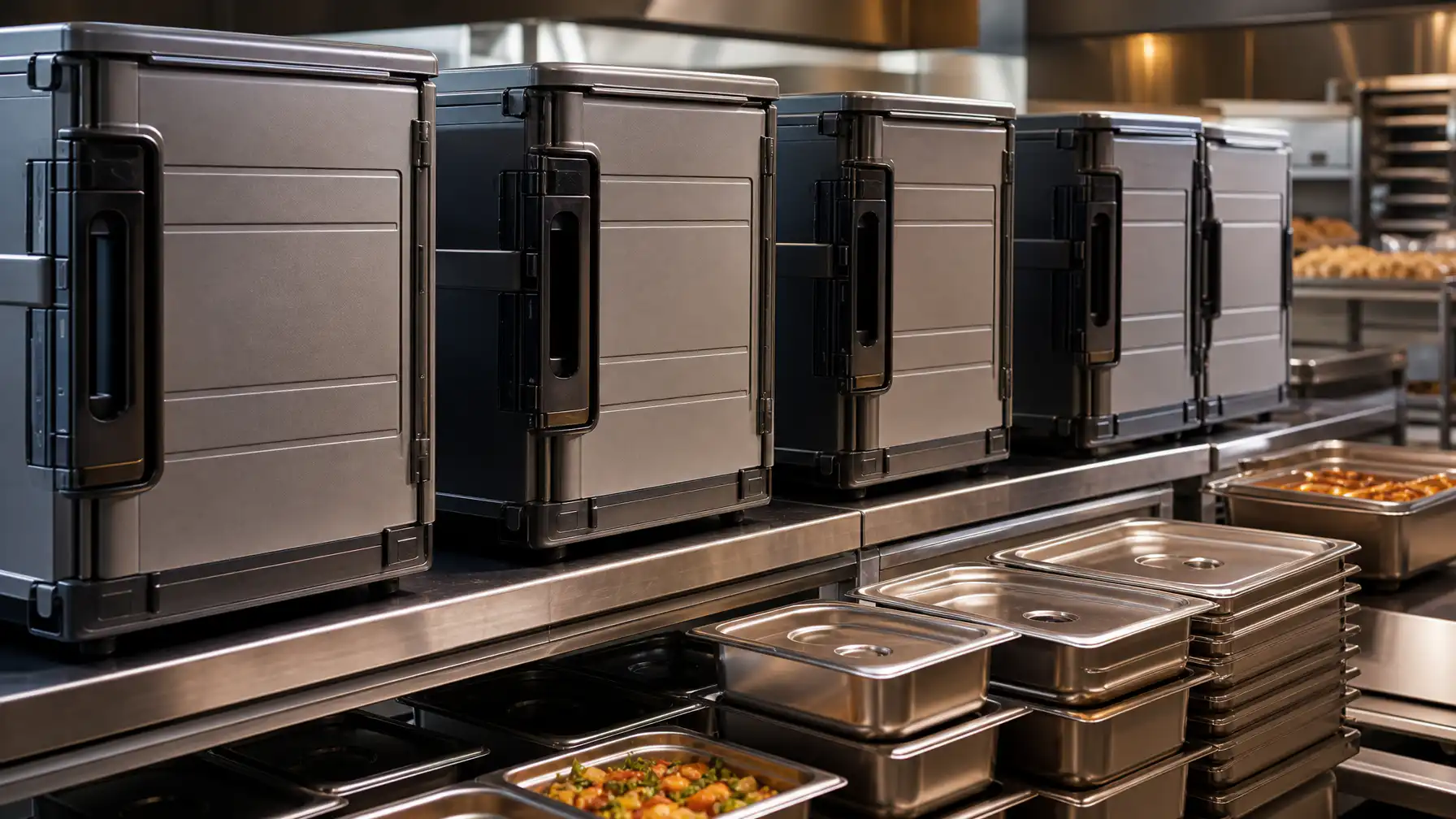
Standard insulated hot boxes use a double-wall construction with polyurethane foam insulation between the inner and outer shells. The inner container accepts gastronorm pans directly, and the lid seals tightly to minimise heat loss.
These units are available in top-load and front-load configurations. Top-load models are loaded from above and are more compact, making them well-suited to event catering transport where space in vehicles is limited. Front-load models open at the front like a cabinet and allow access without fully unloading, which suits venue setup and service contexts where individual gastronorm pans need to be accessed without disturbing the rest of the load.
The holding and distribution range at The Cater-Ring includes insulated hot boxes in multiple sizes, from compact 16-litre units to large 90-litre double-height models, to match different operational scales and transport requirements across South Africa.
Heated Trolleys
Heated trolleys use active electrical heating to maintain temperature rather than passive insulation alone. A heated trolley connects to a power source and its internal heating element keeps the food load at set temperature for as long as required. These are appropriate for in-venue holding rather than vehicle transport.
In hotel and lodge environments where food is prepared in a central kitchen and then held at a satellite service point, a heated trolley maintains temperature without the time limitation of a passive hot box. For service periods extending beyond three to four hours, or where ambient temperatures are very low such as in open-air highveld winter dining, a heated trolley provides greater reliability than a passive unit.
Gastronorm Containers and Food Pan Carriers
Gastronorm pans are the standardised food containers used throughout professional catering. They fit inside hot boxes, bain maries, steam table inserts, and heated trolleys, forming the backbone of any professional food distribution system. The gastronorm (GN) sizing system is the global standard for commercial food service containers and is widely used across South African catering operations.
Common gastronorm sizes used in South African catering:
- GN 1/1 (530 × 325 mm): the full-size standard, used in the majority of South African hot boxes and service equipment
- GN 1/2 (265 × 325 mm): half of a full-size pan, suited to smaller portions or multiple dishes in one hot box
- GN 1/3 (176 × 325 mm): one-third size, useful for buffet service with multiple small portions from a single unit
- GN 2/1 (650 × 530 mm): double size, used in large production and hospital food service contexts
Depth sizes range from 20 mm to 200 mm. The most versatile depth for event catering is 65 mm or 100 mm, which accommodates most prepared food products without excessive dead space in the hot box or unnecessary weight in transit.
How to Choose the Right Hot Box for Your Operation
Determine Your Load Requirements
Calculate the gastronorm pan configuration you need to transport. A standard 30-litre hot box holds one GN 1/1 pan at 200 mm depth, or two GN 1/2 pans. A 90-litre hot box holds six GN 1/1 pans at 65 mm depth. Match hot box capacity to the number of dishes and portion volumes you need to transport in a single load for your typical event or service scenario.
A larger hot box with a partial load retains temperature better than a small hot box filled to capacity, because the air volume inside acts as additional insulation. However, weight, vehicle space, and practical handling set a ceiling on how large a hot box is manageable in a working catering environment.
Assess Your Transport Duration
Quality insulated hot boxes from reputable suppliers maintain food above 60°C for three to six hours under South African ambient conditions. If your transport time from kitchen to service point is consistently under two hours, a standard insulated hot box is sufficient. If you cater at remote lodge locations, rural venues, or operate in cold highveld winters where ambient temperature accelerates heat loss, choose a model with superior insulation ratings or use a heated trolley at the destination venue.
Consider Your Service Context
Front-load hot boxes suit situations where individual pans need to be accessed mid-service without disrupting the rest of the load. Top-load boxes are more compact for transport and suit operations that load at the kitchen and unload completely at the venue. If you serve directly from the hot box rather than transferring to a buffet setup, front-load access is a meaningful operational advantage that reduces handling time during service.
South African Applications
Event Catering
South African event caterers regularly service venues with no kitchen facilities or inadequate holding equipment. A set of quality insulated hot boxes is the primary food temperature management tool for this context. Hot boxes travel in the catering vehicle, maintain food at safe temperature during transport, and continue holding through the service period. This is standard operating practice for wedding, corporate, and private function catering operations across South Africa.
Lodge and Safari Catering
Bush lodges and safari camps frequently have central kitchen facilities and multiple dining locations across a property. Hot boxes transport food from the central kitchen to bush dining setups, riverside service points, and remote accommodation units. In cold highveld mornings and evenings, insulation quality is a significant factor in maintaining acceptable serving temperature over longer transport distances.
Hospital and Healthcare Food Service
Hospital food service in South Africa requires strict temperature compliance at every stage of the food chain. Hot boxes transport meals from central production kitchens to ward serving points, where food is plated and served to patients. In this context, food safety documentation and temperature logging are typically required, and hot boxes with verifiable performance specifications are the standard tool.
School Feeding Programmes
South Africa’s national school feeding programme and private school catering operations both rely on hot boxes for meal transport from central kitchens to multiple serving points across a school campus or across multiple schools in a district. The combination of gastronorm containers and appropriately sized hot boxes creates a repeatable, hygienic, and compliant system for high-volume daily meal distribution.
Food Safety Compliance During Transport
South African food safety compliance during transport requires hot food to remain above 60°C and cold food to remain below 5°C at all times. This is assessed during routine health inspections and is a condition of food service operating licences. Using quality insulated hot boxes, loading food at the correct temperature, and ensuring lids are properly sealed are the practical steps for compliance.
Pre-warming a hot box before loading significantly improves temperature retention. Place hot water or a preheated insert inside for 10-15 minutes before loading food. This technique removes the cold from the insulation walls and prevents the initial temperature drop that occurs when hot food contacts an unheated container. Professional catering operations treat this as standard pre-service preparation.
The Cater-Ring stocks insulated hot boxes, gastronorm containers, and food transport accessories suited to South African event catering, hospital food service, lodge operations, and school feeding programmes. The team advises on the right configuration for your specific transport distances, ambient conditions, and portion volumes.
Frequently Asked Questions
How long does a commercial hot box keep food hot?
A quality insulated commercial hot box maintains food above 60°C for three to six hours under typical South African ambient conditions, provided food is loaded at or above 80°C and the lid is properly sealed. Performance varies by model insulation quality, ambient temperature, and how fully the box is loaded. Pre-warming the hot box before loading improves retention time significantly. Always verify your specific model’s performance under your actual operating conditions before relying on it for food safety compliance.
What is the difference between a hot box and a heated trolley?
A hot box is a passive insulated container that retains heat from the food load. It does not generate heat and requires no power connection. A heated trolley uses an electrical heating element to actively maintain temperature and requires a power source. Hot boxes are the correct tool for transport and remote service where power is unavailable. Heated trolleys are appropriate for in-venue holding where power is accessible and extended holding beyond the passive hot box’s retention capacity is required.
What gastronorm size should I use for event catering in South Africa?
GN 1/1 at 65 mm depth is the most versatile size for South African event catering. It fits the majority of hot boxes, bain maries, and heated trolleys in the local market and accommodates most prepared food products. GN 1/2 pans are useful when serving multiple dishes from a single hot box. For large batch transport, 100 mm or 150 mm depth GN 1/1 pans hold more product per pan. Standardise on a consistent depth within your operation to simplify stacking, storage, and hot box loading.
Do hot boxes need to comply with South African food safety regulations?
Hot boxes themselves are not regulated products, but the temperatures they maintain are subject to South African food safety requirements. Hot food must remain above 60°C throughout transport and service under the Foodstuffs, Cosmetics and Disinfectants Act and related provincial health regulations. Health inspectors can require evidence that your food transport methods maintain safe temperatures. Using a quality commercial hot box with documented insulation performance supports this requirement and demonstrates due diligence in your food safety management system.
Can I use a hot box to transport cold food as well?
Yes. A quality insulated hot box works in both directions: it retains heat when used for hot food and retains cold when used for cold food transport. Pre-cool it with ice or a frozen insert before loading cold items. In South African event catering, dual-use of insulated containers for both hot and cold food transport is common and practical, provided hot and cold items are always transported in separate units and never simultaneously in the same container.