The right catering trolley is invisible during service. Everything moves smoothly, plates arrive on time, glasses stay intact, and staff are not carrying things they should be wheeling. The wrong trolley creates bottlenecks, surface damage, noise, and staff fatigue.
For South African catering operations, from hotel banqueting to event catering companies and restaurant kitchens, the choice of trolley type is a practical decision with real operational consequences. This guide covers every type of catering trolley in common use, what each is built for, and the selection criteria that matter most when specifying or purchasing equipment.
Types of Catering Trolleys Used in South African Hospitality
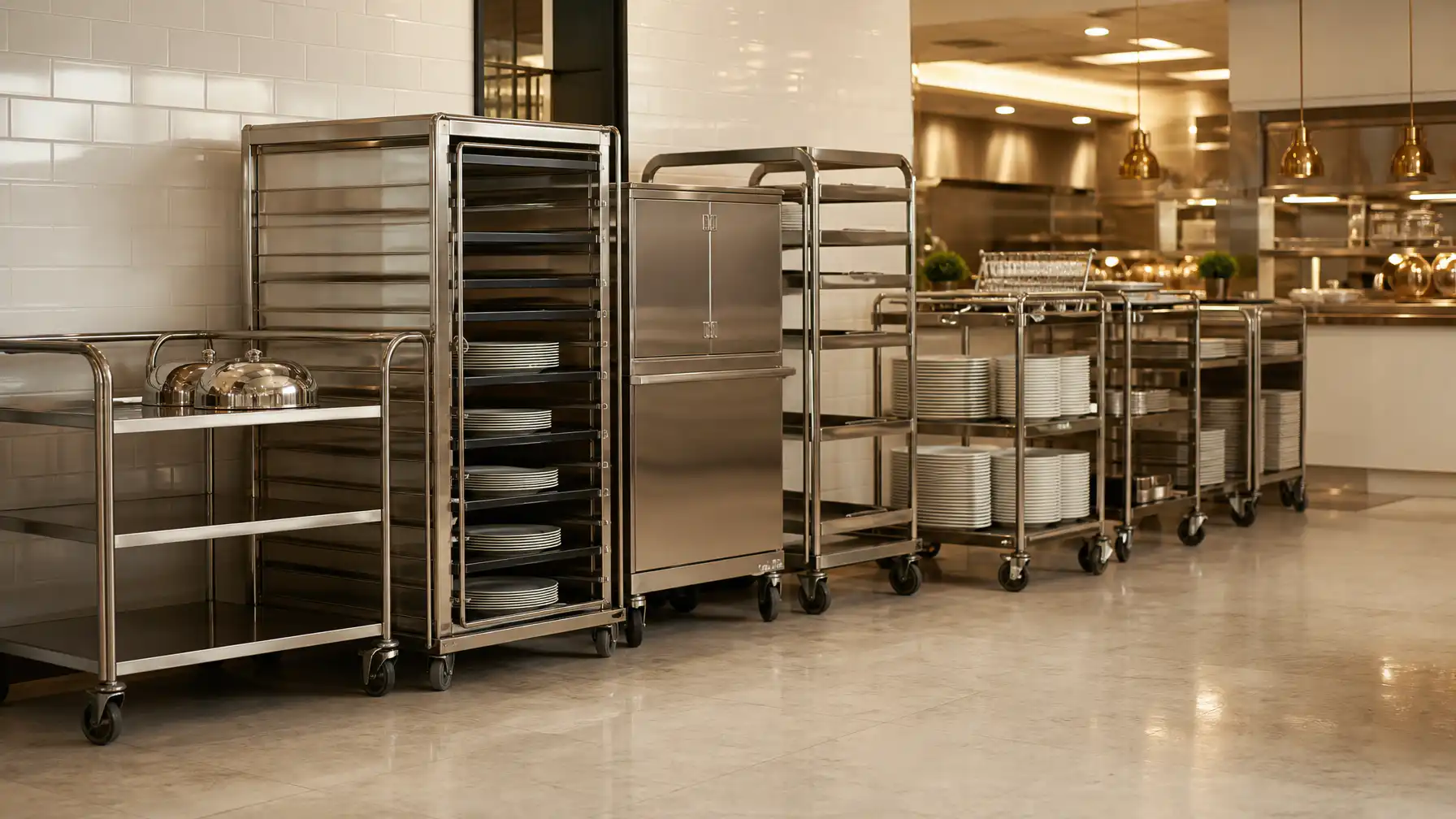
Catering trolleys divide into five functional categories. Each solves a different operational problem, and most commercial kitchens and banqueting operations need more than one type.
Service Trolleys
Service trolleys are general-purpose front-of-house units used to carry food, beverages, crockery, and condiments to and from tables. They typically feature two or three shelves, swivel castors, and a push handle. Grade 304 stainless steel construction is standard for professional use.
In hotel dining rooms and lodge environments, service trolleys handle breakfast buffet replenishment, room service delivery, and clearing duties. In banqueting kitchens, they carry mise en place from the pass to the function floor. For South African restaurants managing high-volume weekend service, a well-specified service trolley with quiet rubber castors and recessed shelf trays reduces glass and plate movement during transport.
Key specifications to check include shelf load rating (typically 30-50 kg per shelf), shelf dimensions relative to your plate sizes, and castor quality. Low-quality castors are the most common failure point on budget trolleys and cause exactly the noise and maneuverability problems that disrupt service.
Plate Trolleys and Lowerators
Plate trolleys, also called lowerators or plate dispensers, hold a stack of plates and use a spring-loaded mechanism to keep the top plate at counter height as the stack depletes. This allows service staff to retrieve a plate with one hand without looking down, which is essential during high-speed plated service.
These are standard equipment in South African hotel banqueting kitchens and large-scale event catering operations. For wedding receptions and corporate banquets where a three-course plated meal is served to 200 or more guests, lowerators at the pass are non-negotiable for maintaining service pace and reducing breakage.
Plate trolleys are sized to a specific plate diameter. Match the trolley to your most-used plate size. Heated versions keep plates warm from below using an electric element, reducing the temperature drop that causes food to cool rapidly on a cold plate.
Glass Trolleys
Glass trolleys are purpose-built for transporting, washing, and storing glassware. They use a rack-within-rack design: the interior holds stackable glass racks that match standard glasswasher rack dimensions (typically 500 × 500 mm). Glassware moves from bar or function room directly into the glasswasher rack, and from there into the glasswasher without repacking.
For South African events and hospitality operations, glass trolleys significantly reduce breakage during service. Glasses transported loose on standard shelving break. Glasses held in purpose-built racks within a protective trolley frame do not. The labour saving from fewer breakages pays for the equipment within the first busy season in a high-volume operation.
Glass trolleys come in 2-rack and 4-rack configurations. Choose based on your glasswasher throughput and the typical event size you cater.
Heated Trolleys
Heated trolleys maintain food at safe serving temperature between the kitchen and the table or buffet. They use electrical heating elements built into a thermally insulated body, typically maintaining 60-85°C internal temperature. Most models accept gastronorm pans (GN 1/1, GN 1/2) directly, which integrates cleanly into a kitchen operating on the gastronorm system.
In South African hotel operations, healthcare facilities, and large lodge environments where kitchens are separated from dining areas by significant distance, heated trolleys are critical for food safety compliance. Under South African food safety regulations, hot food must be held above 60°C throughout service. A heated trolley is what makes this achievable when serving from a remote location or across a large function floor.
Heated trolleys with humidity control are available for operations serving foods that dry out quickly during holding, such as roasted meats and poultry. These units use a water reservoir to maintain moisture alongside temperature.
The full range of holding and distribution equipment at The Cater-Ring includes heated trolleys and insulated hot boxes suited to South African event and hospitality operations of all scales.
Utility and Transport Trolleys
Utility trolleys, also called platform trolleys or transport trolleys, move heavy loads through kitchens, storage areas, and loading bays. They are back-of-house logistics tools rather than front-of-house service items. Their purpose is handling bulk stock movement, crate transport, and kitchen goods logistics.
In large South African hotel kitchens, utility trolleys move deliveries from the loading bay to dry store and cold rooms. In catering companies, they load equipment onto vehicles for off-site events. A well-built utility trolley with a rated platform capacity of 200 kg or more is a logistics asset that reduces staff injury risk and speeds up every delivery and setup operation.
Materials – Stainless Steel vs Chrome Wire
The two dominant materials for commercial catering trolleys in South Africa are grade 304 stainless steel and chrome-plated or epoxy-coated wire.
Grade 304 stainless steel is the professional standard for kitchen and front-of-house environments. It resists corrosion, handles regular cleaning with commercial kitchen chemicals, and maintains appearance over years of use. It is the correct material for anything used in food contact or public-facing service.
Chrome wire is lower cost and suitable for back-of-house dry storage where corrosion exposure is minimal and appearance is not a factor. It is not suitable for repeated wet-area exposure or cleaning with harsh chemicals, which accelerates pitting and rusting. In South African coastal cities where humidity adds a meaningful corrosion factor, stainless steel represents the more durable long-term investment for any trolley that will see regular kitchen use.
Selecting the Right Catering Trolley for Your Operation
Load Capacity
Match trolley load ratings to actual operational use. A service trolley rated at 30 kg per shelf handles crockery and condiments easily. A utility trolley moving beverage crates needs a platform rated at 150 kg or more. Exceeding rated capacity causes frame deformation and castor failure, creating safety hazards and equipment costs far exceeding the upfront investment in a correctly specified unit.
Wheel and Castor Type
Floor type determines castor choice. Hard rubber or polyurethane wheels suit polished concrete and tile, which are the most common kitchen and dining room floor surfaces in South Africa. Carpeted function rooms require a larger wheel diameter to roll without catching. Swivel castors on all four corners allow maximum maneuverability in tight spaces. Rear fixed castors provide better straight-line tracking for heavy loads over longer distances.
Dimensions for Lifts and Corridors
This constraint is frequently overlooked during equipment specification. A trolley that does not fit the service lift in a multi-floor hotel is useless above the ground floor. Standard South African hotel service lift dimensions typically run 1000-1200 mm wide by 1500-2000 mm deep. Measure your lift and service corridor widths before specifying any trolley. Most manufacturers provide trolley footprint dimensions; confirm these against your own measurements during the design or procurement phase.
Noise Level
In fine dining and boutique hotel environments, trolley noise during service is a material consideration. Quality polyurethane castors and properly tensioned shelf fittings run near-silently. Budget trolleys with loose fittings and worn castors create vibration and rattling that disrupts the dining environment. In these settings, a higher upfront investment in a well-engineered trolley is justified by the service experience it protects.
South African Event Catering Context
South Africa’s event catering sector operates across a wide range of environments, from formal hotel ballrooms to outdoor lodge venues, marquee events on wine estates, and large corporate functions in purpose-built event spaces. Each environment creates different trolley requirements.
Outdoor and marquee events typically involve uneven terrain, which requires larger castor diameters and higher ground clearance than indoor trolleys. Lodge and bushveld venues often have narrow doorways and pathways that limit trolley width. For these environments, compact service trolleys with frames of 600 mm or narrower are the practical specification.
For school feeding programmes, community events, and township catering operations, robust utility trolleys for load movement and simple stainless steel service trolleys for food distribution are the appropriate specification. Price is a factor in these markets, but the total cost of ownership argument for stainless steel over chrome wire holds even in lower-cost procurement contexts.
The Cater-Ring supplies and advises on catering equipment for operations across South Africa. If you are specifying a new operation or upgrading existing equipment, the team can advise on the right trolley types for your specific environment, layout, and service model.
Frequently Asked Questions
What is the difference between a service trolley and a utility trolley?
A service trolley is a front-of-house unit designed to carry food, crockery, and beverages during service. It prioritises appearance, quiet operation, and maneuverability. A utility trolley is a back-of-house logistics tool designed to move heavy loads through kitchens, storage areas, and loading bays. The two serve entirely different functions and are not interchangeable.
What material should a commercial catering trolley be made from?
Grade 304 stainless steel is the professional standard for front-of-house and food contact applications. It resists corrosion, cleans easily, and withstands commercial kitchen chemicals. Chrome wire or epoxy wire is acceptable for back-of-house dry storage but is not suitable for wet environments, front-of-house use, or areas exposed to high humidity such as coastal South African kitchens.
How do I choose the right castor type for my catering trolley?
Match castor material to your floor surface. Polyurethane castors perform well on polished concrete, tile, and wood and are the most versatile choice for operations working across multiple floor types. Larger diameter castors handle carpeted surfaces more easily. For multi-floor operations, confirm trolley dimensions fit your service lift before ordering.
What is a lowerator and when do I need one?
A lowerator is a spring-loaded plate dispenser that keeps the top plate at counter height as the stack is removed. It allows one-handed plate retrieval without looking down, which is critical during high-speed plated service. If your operation serves plated meals to 50 or more covers at a time, a lowerator at the pass significantly improves service pace and reduces the risk of drops and breakage.
Are heated trolleys required for food safety compliance in South Africa?
South African food safety regulations require hot food to be held above 60°C throughout service. When food must travel any distance from the kitchen to the service point, a heated trolley is the practical tool for maintaining this temperature. Unheated or uninsulated transport methods put operations at risk of non-compliance and of serving food at unsafe temperatures, with the associated liability that creates.