A commercial kitchen knife works harder than almost any other tool in the operation. A chef working a full service uses their primary knife for four to eight continuous hours, through hundreds of repetitive cuts, across proteins, vegetables, herbs, and garnishes. At that intensity, the difference between a professional knife and a consumer one becomes apparent within the first week of service.
For culinary students, apprentice chefs, and working hospitality professionals across South Africa, the choice of knife set shapes not just daily efficiency, but long-term technique development and physical comfort across a career. The Cater-Ring’s Chef Link range is built specifically for this environment — providing commercially specified tools at a price point suited to both professional kitchens and culinary training programmes.
How Commercial Kitchen Knives Differ from Consumer Knives
Consumer knives are designed for intermittent home use, typically 10–20 minutes of cutting a few times per week. They are often made from lower-grade stainless steel with softer heat treatment, which resists chipping but at the cost of edge retention. They handle well enough for light household use but dull quickly under commercial volume.
Commercial kitchen knives are built for continuous use under demanding conditions. The key differences are in steel grade and heat treatment, handle construction, weight and balance, and overall build tolerance. A professional knife holds a sharp edge through hours of use, is constructed to withstand a commercial kitchen environment including exposure to water, cleaning chemicals, and high-frequency use, and is built to be resharpened dozens of times over its working life without losing performance or structural integrity.
The distinction matters practically. A consumer knife used in a commercial kitchen blunts quickly, requires constant resharpening that wears through the blade faster, and typically has handle construction that degrades under repeated dishwasher cycles or heavy moisture exposure.
The Five Essential Knife Types for a Commercial Kitchen
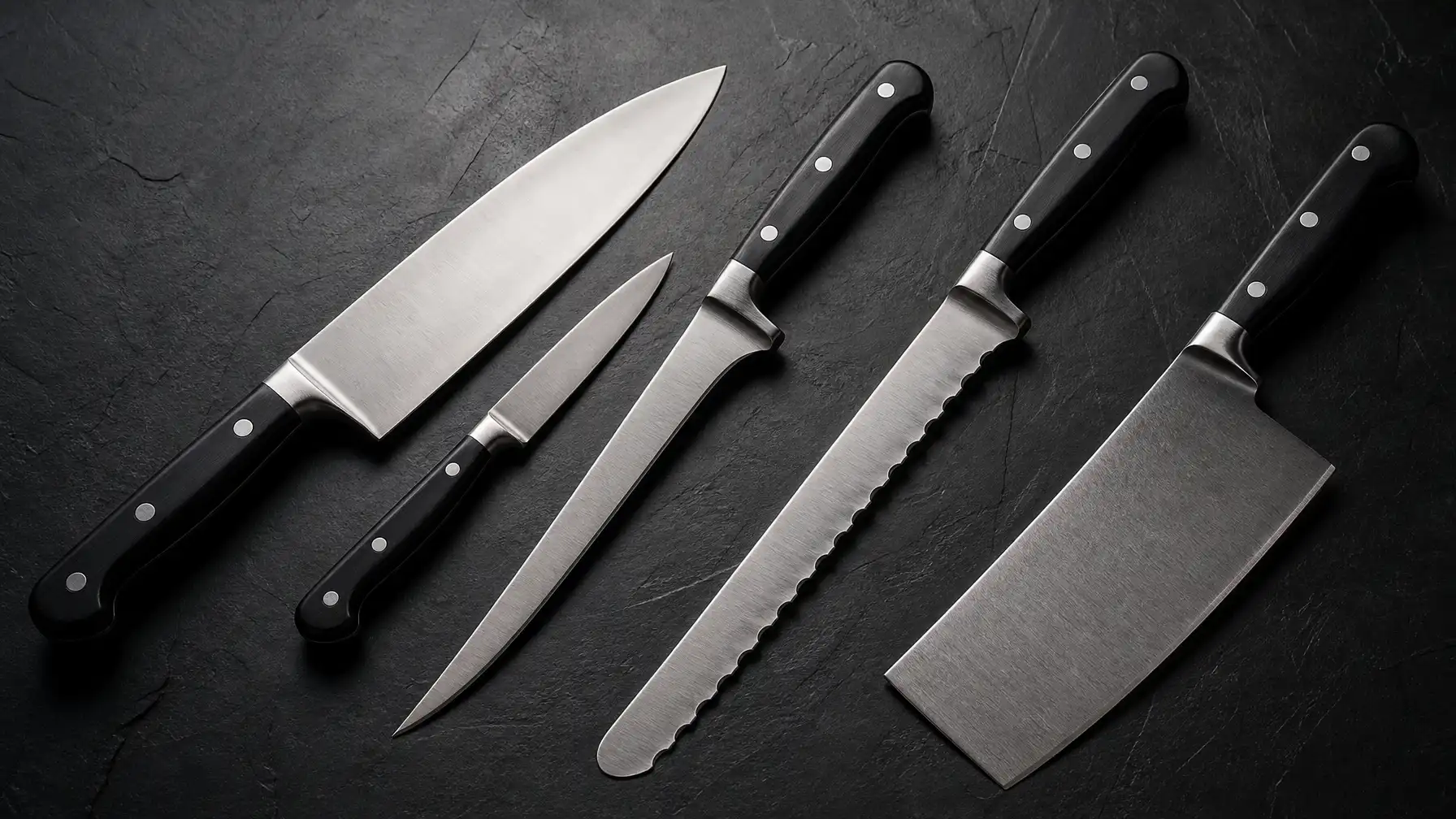
Every commercial kitchen needs a defined core knife set. These five types cover the majority of cutting tasks across most food service operations, from fine dining to institutional catering.
The Cook’s Knife (Chef’s Knife)
The cook’s knife is the workhorse of the kitchen. A blade length of 200–250mm suits most professional applications — long enough for efficient chopping and slicing of large ingredients, manageable enough for precision work on smaller ones. The curved belly of the blade enables a rocking chop, while the straight heel section handles push cuts and heavy breaking-down work on dense ingredients.
Chef Link cook’s knives are available in multiple handle colours, supporting HACCP colour-coding programmes used in professional kitchens to prevent cross-contamination between food categories. The Arcos-branded cook’s knives available through The Cater-Ring’s range provide a European specification blade at a price point suited to commercial kitchen procurement at scale.
The Paring Knife
A paring knife carries a blade of 75–100mm and handles small, controlled work that a cook’s knife cannot manage safely or precisely: peeling, trimming, deveining, garnish work, and fine portioning. Every station in a professional kitchen typically has at least one paring knife within reach throughout service. Chef Link paring knives are available in blade lengths from 90mm and across the full range of HACCP handle colours, including red, black, blue, green, and white.
The Boning Knife
Boning knives are designed for removing bones from raw meat and poultry with minimal waste. The blade is narrow and pointed, built to work along bone and through joints without tearing surrounding muscle. In South African butcheries, hotel kitchen meat preparation sections, and restaurant operations that break down whole or half carcasses on-site, the boning knife is a high-frequency daily tool. The Chef Link Knife Boning Narrow (Torro) is built for this work, with a blade specification suited to the precise, high-repetition demands of commercial meat preparation.
The Bread Knife
A serrated bread knife cuts through crust without compressing the crumb — a task that a straight edge cannot perform effectively without tearing. In a restaurant, hotel, or bakery context, a bread knife with a 200mm or longer blade is a daily necessity. The serrated edge on a quality commercial bread knife lasts considerably longer than on a consumer model and can be professionally re-serrated when it eventually dulls, extending the working life of the knife significantly.
The Meat Cleaver
A cleaver splits through bone and heavy cartilage in a single blow, making it essential for butchery, stockpot preparation, and any kitchen working with whole or half carcasses. The weight of the cleaver does the work. A 180–220mm blade with substantial mass behind it splits cleanly where a standard knife would bind, stall, or chip. The Cater-Ring’s chef knife range includes a 200mm meat cleaver suited to commercial butchery and kitchen use, available through the chef knives category.
What to Look For in a Commercial Kitchen Knife
Steel Grade and Heat Treatment
The steel grade determines how hard the blade can be made and how well it holds an edge. High-carbon stainless steel is the professional standard for commercial kitchen knives — it combines edge retention with corrosion resistance, which is essential in a wet commercial kitchen environment where knives are exposed to water, acids from food, and cleaning chemicals throughout every service.
Heat treatment is expressed as Rockwell hardness (HRC). A blade at 56–60 HRC represents the commercial kitchen standard — hard enough for good edge retention, not so hard that it becomes brittle and prone to chipping on contact with hard materials. Softer consumer-grade steels below 54 HRC roll rather than hold, requiring constant steel honing between tasks.
Handle Construction and Durability
Handle material in a commercial kitchen must be non-porous, slip-resistant when wet, and capable of surviving heavy daily use alongside regular sanitising. Polypropylene handles are the commercial standard — they do not absorb moisture, resist bacterial growth in the handle material itself, and maintain grip through service conditions including wet hands and greasy surfaces. Full tang construction, where the blade steel extends through the full length of the handle, provides better balance and far greater durability than partial tang construction.
Weight and Balance
A well-balanced knife reduces fatigue during extended use. The balance point on a quality cook’s knife sits at or just forward of the bolster, the thick collar between blade and handle. Knives that are blade-heavy cause wrist strain and inaccuracy over long service periods. Handle-heavy knives reduce cutting control. For any knife bought for professional use, holding the knife is the most important evaluation — balance is experienced, not read from a specification sheet.
HACCP Colour Coding
In South Africa’s food service operations, HACCP-compliant colour coding is both a regulatory expectation and a practical discipline for managing cross-contamination risk. The Chef Link range’s multi-colour handle system supports a full colour-coded knife programme without additional investment in holders, tape marking, or coded sheaths. This is a genuine operational advantage in any commercial kitchen preparing food across multiple protein and allergen categories. A consistent colour-coding system also makes it immediately visible to supervisors if the wrong knife reaches the wrong station.
Knife Care and Maintenance in a Commercial Kitchen
Honing
Honing realigns the edge of the blade without removing steel. A honing steel should be used before each service to straighten the micro-edge that folds slightly during cutting. This is fast — 5–10 seconds with a honing steel before service restores working sharpness. The Cater-Ring’s accessories range includes a 300mm honing steel suited to commercial kitchen use, as well as magnetic knife holders for safe edge storage between services.
Sharpening
Sharpening removes material to restore the edge geometry when honing is no longer sufficient to restore cutting performance. For most commercial kitchens, sharpening every 1–3 months depending on use intensity is appropriate. Whetstones give the most control over the angle and finish of the edge. Mechanical sharpeners are faster but remove more material per pass and shorten blade life over time. The Cater-Ring stocks sharpening stones and dual-action hand-held sharpeners through the chef knives accessories range.
Storage
Knives stored loose in a drawer blunt against each other and present a safety hazard to anyone reaching in without looking. Commercial kitchens should use magnetic knife holders, knife blocks, or individual blade guards. The Cater-Ring’s accessories range includes 450mm and 600mm magnetic knife holders suited to wall mounting and counter placement in professional kitchen environments.
Washing
Commercial kitchen knives should be hand-washed and dried immediately after use where possible. Dishwasher cycles can damage handle rivets, cause handle warping from high-temperature water, and result in blade damage from contact with other utensils in the rack. If knives must go through a commercial dishwasher, store them individually and use blade guards to prevent contact damage during the cycle.
The Chef Link Range at The Cater-Ring
Chef Link is The Cater-Ring’s sub-brand for professional and student culinary equipment, covering knives, cookware, and uniforms. The positioning is explicit: professionally specified tools for working chefs, culinary school students, and hospitality professionals who need reliable equipment without the price premium of luxury knife brands.
The knife range includes cook’s knives, paring knives, boning knives, bread knives, and cleavers across HACCP handle colour options. Arcos-branded knives are also available for operators who want European-specification commercial blades with a long track record in professional kitchens. The full Chef Link range on The Cater-Ring’s online store includes uniforms, cookware, and consumables alongside the knife range.
For culinary schools and hospitality training programmes procuring knife sets for an intake cohort, The Cater-Ring supports bulk orders with consistent specifications across all units in the order. This matters in a training environment where every student working with the same knife geometry and weight produces more consistent technique outcomes. Contact our team or visit the consulting services page for bulk supply enquiries and pricing.
Why Knife Quality Affects Both Output and Chef Satisfaction
A dull knife requires more force to cut, which increases fatigue, reduces accuracy, and raises the injury risk that comes from applying excess force with a blade. Over the course of a service, the cumulative effect of working with poor tools is slower prep times, less consistent cuts, higher trim waste from imprecise butchery work, and a less motivated team. None of these outcomes are visible in isolation, but together they affect kitchen profitability and team morale in a way that poor tool choice compounds over time.
Conversely, a kitchen equipped with correctly specified, well-maintained knives works faster, more safely, and with more consistent output. The food preparation equipment a kitchen uses — including its knives — is a direct input to the quality and efficiency of its output. For culinary students, learning technique on quality knives from the start builds better muscle memory and a more accurate understanding of what the tool can do, which carries into professional practice.
The investment in quality knives for a commercial kitchen, relative to the total cost of the kitchen, is modest. The return in operational performance and team satisfaction is not.
Frequently Asked Questions
What steel grade is used in commercial kitchen knives?
The professional standard is high-carbon stainless steel, which combines edge retention with corrosion resistance. Better commercial knives specify both the steel grade and the hardness (HRC). For most commercial kitchen environments, 56–60 HRC provides the right balance of hardness and durability. Harder blades hold an edge longer but are more susceptible to chipping from impact.
How often should commercial kitchen knives be sharpened?
Honing with a honing steel should happen before every service to realign the edge. Sharpening, which removes material to restore edge geometry, should happen every 1–3 months depending on use intensity. A knife in continuous use for 8 hours daily needs more frequent attention than one used for light prep work. A properly honed knife that is sharpened regularly will outlast and outperform a neglected one regardless of the original quality.
What is HACCP colour coding and why does it matter for knives in South Africa?
HACCP colour coding assigns different coloured knife handles to different food categories to prevent cross-contamination. Red for raw red meat, green for vegetables, white for dairy and bakery, yellow for raw poultry, blue for raw fish, and brown for cooked meats are the standard allocations. In South African food service operations, colour-coded knife systems are an industry standard and align with food safety regulations. The Chef Link range supports this system with multi-colour handle availability across the core knife types.
Can Chef Link knives be used by culinary students?
Yes. Chef Link is specifically designed to serve culinary students and hospitality training programmes alongside professional kitchen operations. The range provides commercially specified tools at a price point suited to student procurement, and the colour handle range makes them directly compatible with HACCP-compliant kitchen environments at culinary schools. The Cater-Ring supports bulk procurement for training intake groups.
Where can I buy Chef Link knives in South Africa?
Chef Link knives are available through The Cater-Ring’s online store. The full range, including cook’s knives, boning knives, paring knives, bread knives, cleavers, and accessories, is available at caterring.co.za. For bulk orders or culinary school supply enquiries, contact our team on +27 10 109 2104 or through our consulting services page.