South Africa’s food service sector has seen a genuine shift in consumer expectations around frozen desserts. The South African ice cream market reached USD 363.1 million in 2025 and is projected to grow to USD 469.2 million by 2034. Within that growth, the artisanal and premium segment is outpacing the mainstream one — driven by restaurant dessert menus, specialty gelato shops, and hospitality venues that want a point of difference on the plate.
For any food service operator considering this category, the first decision is not a flavour or a brand. It is the machine. Gelato and ice cream require fundamentally different equipment, and choosing the wrong machine produces the wrong product regardless of how good your recipe is.
This guide covers the commercial machines behind both products, how they work, which type suits your operation, and how to size correctly for your production volume and service model.
Why Gelato and Ice Cream Require Different Machines
The difference between gelato and ice cream is not cosmetic. It starts at the structural level and is determined entirely by how the freezing process is engineered. Understanding these differences is the only way to make the right equipment decision for your business.
Overrun
Overrun is the volume of air incorporated into the mix during churning, expressed as a percentage increase over the base mix volume. Standard ice cream carries an overrun of 80–100%, which is why a tub of commercial ice cream feels light and melts quickly. Traditional Italian gelato keeps overrun at 25–35%, producing a denser, creamier product with more concentrated flavour per gram.
Achieving low overrun requires a machine that churns more slowly and at higher torque. An ice cream machine run at gelato-correct speeds and temperatures will not produce authentic gelato texture. The dasher (the internal paddle) design, the motor speed, and the freezing cylinder are all engineered differently between the two machine types.
Serving Temperature
Gelato is served at a warmer temperature than ice cream, typically between -10°C and -12°C compared to ice cream at -15°C to -18°C. This is not a storage compromise. It is intentional. The warmer serving temperature keeps gelato pliable for scooping and allows flavour compounds to be more volatile on the palate. This means your display and holding equipment must also be specified correctly, not just the production machine.
Fat and Milk Ratio
Gelato uses less cream and more milk than ice cream, resulting in lower butterfat content. This changes how the mix behaves during freezing. Gelato machines are engineered for lower-fat mixes, with tighter temperature control and extraction timing to prevent iciness. A machine calibrated for high-fat ice cream mixes will not produce the same result when running a gelato base.
Types of Commercial Gelato and Ice Cream Machines
Commercial machines fall into three main categories. Each serves a different scale and service model.
Batch Freezers
A batch freezer processes one batch of mix at a time, typically between 3 litres and 15 litres depending on the model. You load the mix, set the cycle, and the machine churns and freezes simultaneously. When the cycle completes, you extract the product into a pan and place it in a hardening cabinet or display freezer for service.
Batch freezers are the standard machine for artisan gelato shops, boutique dessert bars, and restaurants producing small daily volumes of premium product. They give you full control over each batch, which means you can change flavours frequently and adjust recipes from one production run to the next. For South African operations targeting the premium dessert market in Cape Town, Johannesburg, or Durban, a batch freezer in the 5–8 litre range typically suits an opening-size gelato operation.
Continuous Freezers
Continuous freezers are designed for high-volume ice cream production. Mix feeds in continuously on one side and finished product exits on the other, with overrun controlled by the speed of air injection. These machines produce hundreds of litres per hour and are used by commercial ice cream manufacturers and large institutional catering operations.
For most South African restaurant or food service operations, a continuous freezer is oversized and impractical. They require skilled operators, consistent mix supply, and high throughput to run economically. If you are supplying ice cream to a large banqueting operation, hotel chain, or event catering business at volume, a continuous freezer may be worth evaluating. For most operators, a batch freezer is the practical starting point.
Soft Serve Machines
Soft serve machines operate differently from both batch and continuous freezers. They hold a liquid mix in a refrigerated hopper and freeze it to a semi-soft consistency on demand, dispensing through a valve. Soft serve typically carries an overrun of 30–50% and is served immediately at dispensing temperature.
Soft serve machines are well suited to fast food operations, school canteens, food courts, and dessert stations where throughput and speed matter more than artisan quality. They do not produce gelato or hard ice cream. They represent a separate product category with a separate machine specification.
Choosing the Right Machine for Your Operation
Artisan Gelato Shops and Specialty Dessert Venues
A batch freezer with a production capacity of 4–10 litres per batch, paired with a purpose-built gelato display cabinet, is the standard setup for a standalone gelato operation. You will typically need two to three production cycles per day to keep display cases stocked. For South African operations in high-footfall retail or tourism-facing locations, factor in significant seasonal demand variation, with summer months particularly in coastal cities driving peak throughput requirements.
Restaurant Dessert Menus
Restaurants adding gelato or premium ice cream to their dessert menu need lower daily volumes but higher consistency across service periods. A compact batch freezer producing 2–3 cycles per service is usually sufficient. Pair it with a blast chiller for rapid hardening and a properly specified display or holding freezer. Your refrigeration equipment choice is as critical as the gelato machine itself to the final product quality.
Hotels and Banqueting Operations
Hotels serving gelato or ice cream at buffet stations and banqueting events face a different challenge: large batch requirements with predictable high-volume windows. A mid-range batch freezer producing 8–15 litres per cycle, with multiple cycles possible during the production window, is often more appropriate than a continuous freezer for operations at this scale. Pair this with adequate blast chilling and a clearly planned holding and distribution system to maintain quality between production and service.
Display and Storage Requirements
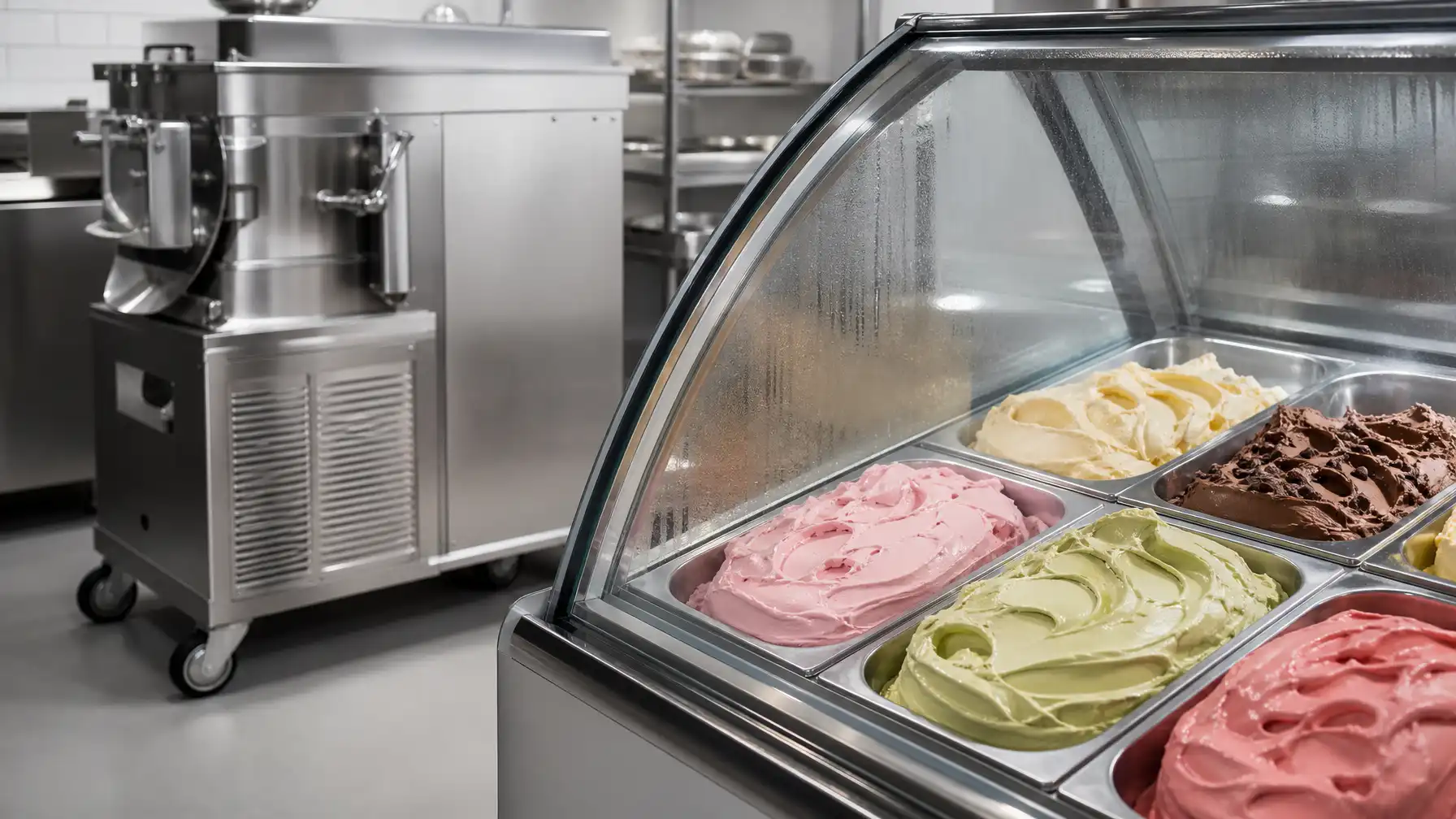
The gelato machine handles production. The display cabinet handles the sales environment, and it is a separate purchasing decision that has a direct impact on product quality and sales volume.
Gelato display cases maintain product at -10°C to -12°C under curved or flat glass with interior lighting designed to show product colour and texture. They are not standard refrigeration units. Using a regular chest freezer or upright freezer to display gelato results in incorrect temperatures, ice crystal formation on the product surface, and a presentation that works against the premium positioning you have invested in producing.
For ice cream displayed in tubs or containers, the same principle applies. Specify a display unit calibrated for your required display temperature and matched to your service format, whether counter-level scooping or self-serve.
Production Capacity Sizing
A common planning error is purchasing a machine based on aspired sales volume rather than realistic daily demand. A 15-litre batch freezer sitting idle at 20% utilisation is a poor investment. A 6-litre machine running at 80% utilisation across a full shift is far more economical to operate and maintain.
Work backward from the number of covers or servings you expect per service period. A standard gelato portion is 90–120g. If you expect to serve 80 portions per day across two service periods, you need approximately 8–10kg of finished product daily. A 5-litre batch freezer producing roughly 4–5kg per cycle can cover this comfortably with two cycles, leaving room for flavour variety and a production buffer for peak days.
If you are unsure about the right capacity for your operation, The Cater-Ring’s consulting services team can help you scope your equipment requirements before purchase, and advise on the full cold chain setup from production through to display.
Energy and Operational Considerations for South African Operators
South Africa’s energy environment adds a layer of complexity that operators in other markets do not face to the same degree. Load shedding affects production scheduling, cold chain reliability, and the viability of equipment that requires continuous operation.
Batch freezers are well suited to interrupted power environments because they operate in discrete production cycles. You schedule production around known load shedding schedules and store finished product in well-insulated holding freezers. Continuous freezers are more vulnerable to interruptions: stopping mid-production wastes the in-process mix and may require a machine cleaning cycle before the next run.
Energy efficiency ratings on commercial refrigeration and freezing equipment are increasingly significant as energy costs rise. When comparing machines, look at the compressor type (scroll compressors are generally more efficient), the refrigerant specification, and the insulation quality of the unit. These factors determine your ongoing running costs over the operational life of the equipment, which for a well-maintained commercial batch freezer is typically 10–15 years.
The Cater-Ring’s full commercial cooking and production equipment range complements a gelato setup, and our team can help you design a complete dessert production setup suited to your kitchen footprint and power supply.
Frequently Asked Questions
Can I use an ice cream machine to make gelato?
Technically possible in some cases, but the results will be inconsistent. Gelato requires lower overrun and different extraction timing than ice cream. A machine engineered for high-overrun ice cream will not consistently produce the density and texture that defines authentic gelato. For commercial operations, specifying the correct machine for the product you intend to produce is the right approach.
What is the typical lifespan of a commercial batch freezer?
A well-maintained commercial batch freezer typically lasts 10–15 years. Lifespan depends on usage intensity, cleaning frequency, and refrigerant maintenance. Regular service intervals for the compressor, dasher, and seals extend operational life significantly. Buying a reputable brand with a local service agent in South Africa is important for this reason.
Do I need a separate blast chiller with a batch freezer?
For artisan gelato production at commercial scale, yes. Batch freezers extract product at a soft consistency that needs rapid hardening to set texture and prevent ice crystal formation. A blast chiller brings product down to holding temperature quickly and is a standard part of a complete gelato production setup. Without it, you rely on slow hardening in a standard freezer, which compromises texture quality.
What refrigeration equipment do I need alongside a gelato machine?
At minimum, you need a blast chiller or blast freezer for hardening, a holding freezer for storing finished product, and a display case calibrated for gelato service temperatures. Depending on your volume, you may also need a refrigerator for holding base mixes before production. The Cater-Ring’s full refrigeration equipment range covers all of these requirements.
Where can I get advice on selecting the right gelato machine for my South African operation?
The Cater-Ring supplies commercial kitchen equipment across South Africa and can advise on machine selection, capacity planning, and full kitchen setup for frozen dessert production. Contact our team or visit our consulting services page for a tailored recommendation suited to your operation.