Ice is a utility in food service — not an afterthought. The moment your machine runs short during a busy Friday night service, or produces the wrong type of ice for your application, it becomes a direct operational problem. For South African restaurants, bars, hotels, and catering operations, selecting the right commercial ice machine involves more than picking a production capacity number off a spec sheet.
This guide covers ice machine types, how to match production capacity to daily demand, the role of water quality and filtration in South African conditions, energy efficiency, and the most common failure causes and how to prevent them.
Understanding Ice Machine Types
Commercial ice machines produce different ice forms, each suited to specific applications. Understanding the difference is the first step to a correct purchase decision.
Cubed Ice Machines
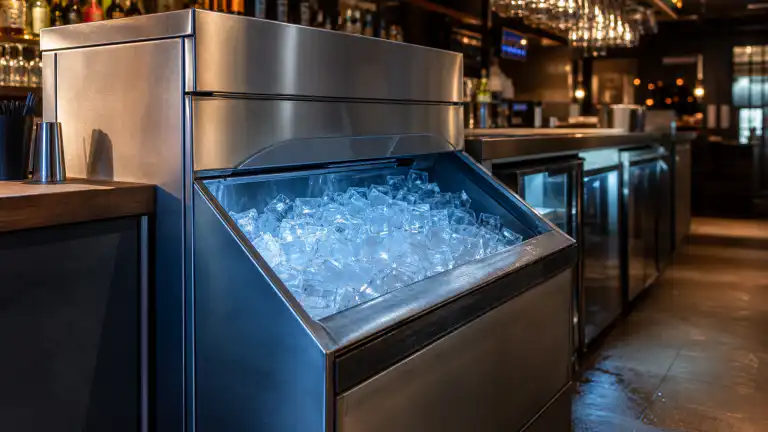
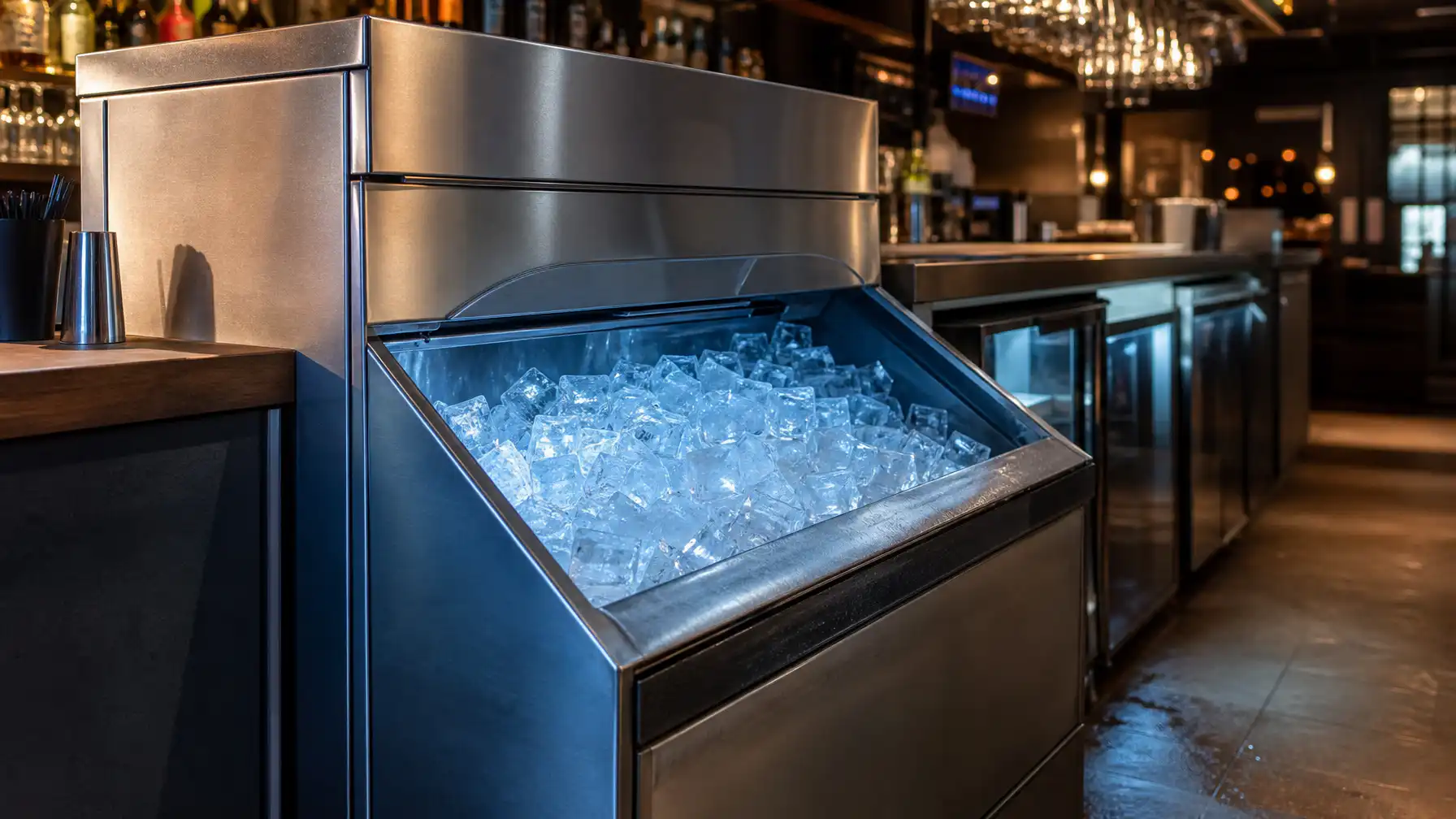
Cubed ice is the most versatile form and the standard for beverage service. It melts slowly, so it keeps drinks cold without diluting them quickly. Cube size varies by machine — full cube, half cube, and dice cube — and each has slightly different beverage and cocktail applications.
Half-cube or dice ice is the most popular in South African restaurants and bars because it packs efficiently in glasses and dispensers, gives good beverage-to-ice ratio, and is easy to scoop.
Cubed ice machines suit restaurants, bars, cafes, hotels, and any beverage-forward operation.
Flaked Ice Machines
Flaked ice produces soft, irregular ice particles with a high surface area and rapid chilling effect. This makes it ideal for:
- Food display and fresh produce presentation (fish markets, deli counters, seafood restaurants)
- Blended drink preparation and smoothies
- Medical and healthcare applications (cold therapy, specimen cooling)
- Salad bar and buffet food display
Because flaked ice melts faster than cubed ice, it is not suited for standard beverage service where drink dilution matters. South African seafood restaurants, fisheries, and butcheries with fresh product display cases benefit significantly from flaked ice.
Nugget Ice Machines
Nugget ice (also called pearl ice or chewable ice) is compressed flake ice formed into small, rounded nuggets. It is soft, chewable, and absorbs the flavour of beverages — which makes it popular in fast food environments and specialty beverage applications. Sonic Drive-In in the United States built a significant brand identity around their nugget ice.
In the South African context, nugget ice machines are less common than cubed ice units but are growing in popularity in fast-casual and quick-service restaurants.
Tube Ice Machines
Tube ice produces hollow cylindrical ice pieces. Tubes are slow-melting, making them suitable for bagged ice applications, cooler bags, and high-volume beverage operations where slow melt rate is important. Tube ice machines are more common in ice packaging operations and are less relevant to standard food service.
Matching Production Capacity to Daily Demand
Production capacity on ice machine specifications is quoted in kilograms per 24 hours at a reference temperature (typically 21°C ambient, 15°C water). This is important context: in South Africa, particularly in hot coastal regions and during summer, ambient temperatures regularly exceed 25–30°C, which reduces actual ice production by 10–20% below the rated specification.
Calculating Your Daily Ice Requirement
Use the following benchmarks as a starting point:
| Application | Ice Required |
|---|---|
| Beverage (cold drink, cocktail) | 0.2 – 0.4 kg per drink |
| Full-service restaurant (per cover) | 0.2 – 0.3 kg per cover |
| Bar (per customer, per hour) | 0.2 – 0.5 kg |
| Fresh produce display (per kg of product) | 0.5 – 1 kg of ice |
| Hotel ice machine (per guest room) | 0.5 – 0.7 kg per day |
Multiply your daily customer or product volume by the applicable factor to get your total daily ice requirement in kilograms.
Always add a 25–30% buffer to this figure to account for:
- Temperature reduction in production during hot summer months
- Peak demand surges during busy service periods
- Ice losses from melting during storage and handling
- Machine downtime during cleaning and maintenance cycles
Storage Bin Sizing
Production capacity and storage capacity are separate specifications. The storage bin holds the ice the machine has produced during off-peak hours, so it is available immediately during peak demand. A machine producing 80kg per day but with only a 20kg bin will run empty during a busy lunch service even though it has sufficient daily output.
As a rule: your storage bin should hold at least 30–50% of your daily ice demand so that ice is available at the start of peak service without running the machine continuously.
Water Quality and Filtration in South Africa
Water quality is the single most common cause of commercial ice machine problems in South Africa, and it is consistently underestimated by buyers.
South African municipal water quality varies significantly by region:
- Inland highveld regions (Johannesburg, Pretoria, Ekurhuleni): Generally harder water with higher dissolved solids, calcium, and magnesium. Scale buildup in ice machines is accelerated.
- Cape Town and Western Cape: Softer water, lower scale risk, but seasonal variation in total dissolved solids.
- KwaZulu-Natal coast: Moderate hardness with higher chloride content in coastal areas, which increases corrosion risk in internal water pathways.
Why Water Quality Matters
Ice is literally frozen water, so water quality directly affects ice clarity, taste, and safety. More critically for the machine:
- Calcium and magnesium scale accumulates on evaporator plates, water distribution lines, and sensors. Scale is an insulator, reducing heat exchange efficiency and forcing the refrigeration system to work harder. Over time, this causes premature compressor failure.
- High sediment blocks water inlet filters and distribution nozzles.
- Chlorine and chloramines in municipal supply water degrade internal components over time.
Filtration Requirements
Install a dedicated water filtration system on the ice machine supply line. A two-stage filter addressing sediment (5-micron pre-filter) and taste/odour (carbon block filter) is the minimum standard. In hard water areas, add a scale inhibitor cartridge or full water softener on the supply line.
Replace filter cartridges on schedule — not on appearance. A clogged filter restricts water flow, which causes the machine to produce small, malformed ice and can trigger low-flow fault codes.
This applies equally to our refrigeration equipment range, where water quality affects condenser performance and system longevity.
Energy Efficiency
Ice machines run continuously — 24 hours per day in most commercial operations. Energy consumption is therefore a significant operating cost. In South Africa's current electricity tariff environment, the difference between an efficient and an inefficient machine can amount to several thousand rand per year.
Air-cooled vs water-cooled condensers:
- Air-cooled machines dissipate heat via a fan and condenser coil into the surrounding air. They are more energy-efficient and simpler to install. The trade-off is that they add heat to the kitchen environment — relevant in hot South African kitchens — and performance drops as ambient temperature rises.
- Water-cooled machines reject heat via a water-cooled condenser. They perform more consistently in hot environments and do not heat the kitchen, but they consume additional water, which conflicts with water conservation priorities in South Africa's water-scarce context.
For most South African food service operations, air-cooled machines are the practical choice, provided they are installed in a well-ventilated location with adequate airflow clearance (minimum 150mm on all sides).
Installation Requirements
A commercial ice machine needs the following:
- Dedicated water supply line with isolating valve and filter system
- Floor drain within reach of the machine's drain hose (gravity drain is standard; some machines require a pump if floor drain position is inconvenient)
- Electrical supply matched to the machine's power specification — most under-counter and modular units run on single-phase 220V
- Adequate ventilation — air-cooled machines require unobstructed airflow; do not install in enclosed cupboards without ventilation
- Level installation surface — ice machine evaporators are sensitive to machine levelness; an unlevel machine can cause distribution problems and malformed ice
Our consulting services team can review your kitchen layout and confirm installation requirements before you purchase.
Common Failure Causes and How to Prevent Them
The majority of commercial ice machine failures in South Africa have preventable causes:
| Failure Cause | Prevention |
|---|---|
| Limescale on evaporator | Water filtration and regular descaling (every 3–6 months in hard water areas) |
| Blocked condenser (air-cooled) | Monthly cleaning of condenser coil with a soft brush or compressed air |
| Clogged water inlet filter | Replace filter cartridges on schedule (every 3–6 months) |
| Blocked water distribution nozzles | Weekly inspection and manual cleaning |
| Compressor failure from overheating | Ensure adequate ventilation clearance; do not restrict airflow |
| Mould and biofilm in ice path | Monthly sanitisation of ice-contact surfaces with food-safe ice machine cleaner |
| Load-shedding related damage | Install surge protection on the power supply line |
Regular preventive maintenance by a qualified refrigeration technician is the most cost-effective way to extend machine life. Budget for a service call every six months.
Frequently Asked Questions
How much ice does a restaurant need per day?
A full-service restaurant with 100 covers per service typically requires 20–40kg of ice per day for beverage service alone. Factor in any food display, bar service, or blended drink preparation separately. Add 25–30% to your baseline calculation to account for summer temperature impacts on machine output and peak demand surges. When in doubt, size up rather than down.
What is the best type of ice for a South African bar?
Half-cube or dice cube ice is the most practical for bar service in South Africa. It packs efficiently into highball and rocks glasses, has a moderate melt rate that keeps drinks cold without rapid dilution, and is compatible with standard bar scoops and ice dispensers. For cocktail applications requiring faster dilution and chill (such as stirred drinks), a smaller cube format is preferable.
How often should a commercial ice machine be cleaned?
Ice machines require cleaning and sanitising at minimum every six months, and more frequently in high-humidity environments or where local water quality promotes faster scale and biofilm buildup. Condenser coils on air-cooled machines should be cleaned monthly. Water inlet filters should be replaced every three to six months. Neglecting this schedule dramatically shortens machine life and poses a food safety risk, as ice machines are classified as food contact surfaces.
Does load-shedding damage commercial ice machines?
Repeated power interruptions during load-shedding can damage compressors through voltage fluctuations at restart and through thermal cycling (warm-up and cool-down cycles compress refrigerant oil and can accelerate seal wear over time). Install a surge protection device on the machine's power supply. If your operation runs a generator, confirm that generator output voltage and frequency are stable before starting the ice machine.
Can I use a domestic ice maker in a commercial kitchen?
Domestic ice makers are not suitable for commercial food service environments. They lack the production capacity, build quality, and hygienic design required for continuous commercial operation. They also do not meet NSF or food safety certification standards required for commercial food contact surfaces. For any commercial application — restaurant, bar, hotel, or catering — a purpose-built commercial ice machine is required.