In a South African catering kitchen, the quality and speed of food preparation determines whether you can deliver on your service promises at volume. Great ingredients and skilled staff can only perform as well as the preparation environment and equipment allow. When prep tools are inadequate, your team compensates with more time and more effort, both of which have a direct cost.
This guide covers the essential food preparation equipment categories every South African catering business needs, what to look for when selecting each, and how the right prep setup changes your kitchen's output capacity and consistency.
Why Food Preparation Equipment Drives Overall Kitchen Performance
The preparation stage sits between procurement and cooking, it is where raw ingredients are transformed into service-ready components. The speed, accuracy, and hygiene with which this transformation happens determines:
- How much your team can produce per shift
- The consistency of portion sizes and finished product quality
- Food safety compliance during handling and processing
- How physically demanding the work is for your staff over a full service
Under-investing in food preparation equipment while investing heavily in cooking equipment is a common imbalance in South African commercial kitchens. The fastest range in the world cannot compensate for a prep team that is behind on output due to inadequate equipment.
Food Processors
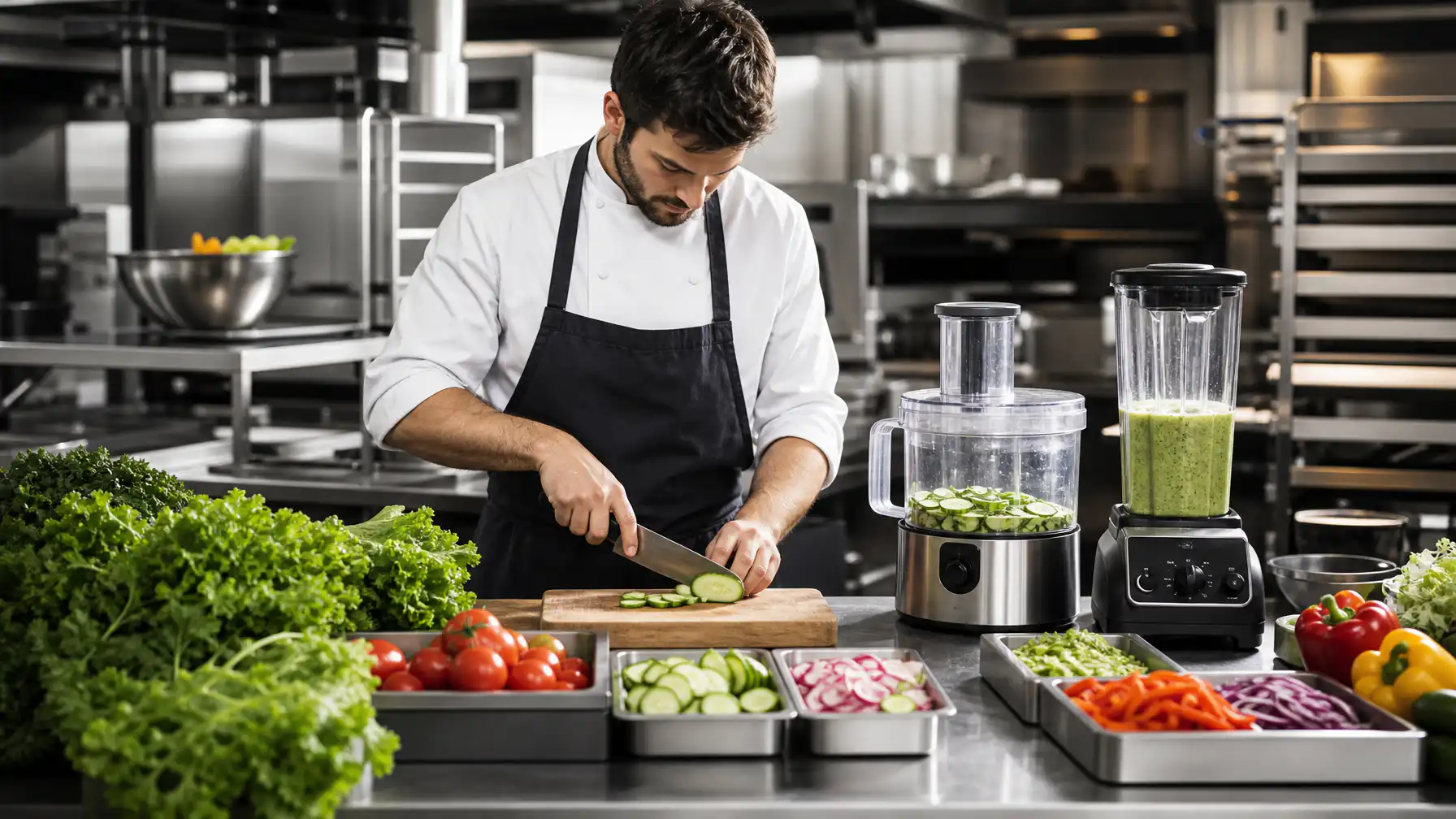
A commercial food processor handles the tasks that would otherwise require the most time during prep: chopping, slicing, dicing, shredding, and pureeing at volume. For a catering kitchen producing high-volume soups, sauces, salads, and garnishes, a food processor replaces hours of manual knife work with minutes of consistent, repeatable output.
When selecting a food processor for a South African commercial kitchen, consider:
- Bowl capacity: Matched to your largest single-batch preparation need
- Motor power: Commercial food processors need sufficient motor power to handle dense vegetables and fibrous ingredients without overheating under sustained use
- Blade and disc variety: Different blades and discs allow the same unit to perform multiple preparation tasks, slice, grate, julienne, and chop, without additional equipment
Commercial Blenders
Commercial blenders are essential for soups, sauces, marinades, smoothies, and any preparation requiring a smooth, uniform consistency at speed. The key distinction between domestic and commercial blenders is not just motor power, it is the ability to handle repeated high-volume batches across a full shift without performance degradation.
For South African catering operations, a commercial blender that is used for soup production, sauce bases, and beverages must:
- Handle hot liquids safely (commercial jug designs prevent pressure build-up from hot contents)
- Produce consistent results regardless of ingredient density
- Clean quickly between batches, commercial blender designs allow rapid disassembly and cleaning
Meat Slicers
Meat slicers are a precision tool for any South African catering business serving deli meats, cured products, biltong, or any protein requiring uniform, thin slicing at volume. The commercial advantage of a slicer over manual cutting:
- Portion control: Consistent slice thickness ensures consistent portion weight, protecting your margins
- Speed: A commercial slicer produces far more uniform slices per minute than any manual alternative
- Presentation quality: Uniform slices present better on a platter, in a sandwich, or on a buffet
Commercial slicers require proper training and strict safety procedures, the blade is extremely sharp. They also require careful daily cleaning, as meat residue on the blade or housing creates a significant bacterial contamination risk.
Commercial Scales
Accurate measurement underpins portion control, recipe consistency, and pricing accuracy in any commercial kitchen. Commercial kitchen scales rated for catering use provide the precision needed to:
- Ensure consistent portion sizes across your entire production run
- Verify ingredient quantities against recipes to maintain food cost targets
- Price accurately for retail or catering event sales where customers are buying by weight
Scales used in South African commercial kitchens should be verified regularly against a known weight to confirm accuracy, and replaced when any drift from calibration is detected.
Vegetable Preparation Equipment
For catering operations producing large volumes of vegetable-based dishes, salads, or garnishes, dedicated vegetable preparation equipment significantly reduces the labour involved in this task:
- Vegetable peelers: Commercial rotary peelers peel large volumes of root vegetables (potatoes, carrots, beetroot) quickly with minimal manual effort
- Mandoline slicers: For consistent ultra-thin slicing of vegetables for salads and garnishes
- Vegetable choppers and dicers: Produce uniform cuts at volume, critical for even cooking and professional presentation
Cutting Boards and Surface Organisation
Food safety regulations in South Africa require that different food categories, raw meat, poultry, fish, vegetables, and ready-to-eat foods, are prepared on separate, colour-coded cutting boards to prevent cross-contamination.
The internationally adopted colour-coding system:
| Board Colour | Food Category |
|---|---|
| Red | Raw meat |
| Yellow | Raw poultry |
| Blue | Raw fish and seafood |
| Green | Salads and fruit |
| White | Dairy and bread |
| Brown | Vegetables |
Using this system consistently, and having sufficient boards in each colour to support simultaneous prep across categories, is both a food safety requirement and a practical workflow tool. Health inspectors in South Africa specifically look for evidence of this system during inspections.
Professional Knives
The most-used tools in any catering kitchen are knives. Professional chef knives from The Cater-Ring's Chef Link range are designed for sustained commercial use, maintaining their edge under the cutting demands of a full service and reducing the hand and wrist fatigue that comes from using dull or poorly-balanced knives.
A professional knife set for a South African commercial kitchen should include:
- Chef's knife: The primary all-purpose cutting tool
- Boning knife: For portioning proteins and removing bones
- Paring knife: For detailed trimming and garnish work
- Bread knife: Serrated for clean cuts through crusty breads and pastries
- Carving knife: For service-side slicing of large proteins
Knife care, proper storage on a magnetic rack or in a knife roll (not loose in a drawer), regular honing during service, and periodic professional sharpening, significantly extends knife life and maintains the cutting quality that protects both food quality and staff safety.
Food Storage Containers
Proper ingredient storage between prep and use protects product quality and hygiene. South African commercial kitchens require food-safe, covered containers that:
- Are made from food-grade materials (no reactive metals or non-food-safe plastics)
- Can be clearly labelled with content and date
- Seal properly to prevent cross-contamination and dehydration
- Are compatible with the GN (gastronorm) sizing standard for use in bain maries, refrigerators, and transport systems
GN-compatible containers allow ingredients prepped in the kitchen to move directly into service equipment (bain maries, holding cabinets) without decanting, reducing handling, saving time, and reducing contamination risk.
The Role of the Prep Station in Kitchen Workflow
Even the best preparation equipment performs below its potential if the prep station it sits on is poorly organised. Effective prep station design:
- Places the food processor, slicer, and scale within the immediate work zone, not across the kitchen
- Provides adequate clear stainless steel surface area adjacent to each piece of preparation equipment
- Has a hand-wash sink accessible within the prep zone for hygiene compliance during preparation
- Has cold storage access nearby for ingredients that must remain chilled during prep
- Stores cutting boards, knives, and small tools within immediate reach without requiring staff to leave the station
When prep equipment and station design work together, your kitchen's preparation capacity and output quality both improve, without requiring more staff or longer prep time.
Frequently Asked Questions
What is the most important food preparation equipment for a South African catering business?
The answer depends on your menu, but for most South African catering operations, a commercial food processor and a reliable set of professional chef knives provide the broadest return on investment. These two categories handle the widest range of prep tasks and are used in virtually every service. A commercial slicer is the next priority for operations serving deli or sliced products.
How do I maintain commercial food preparation equipment?
Daily cleaning after each use, following manufacturer instructions for each unit, is the primary maintenance requirement. For slicers, this means careful disassembly and cleaning of the blade housing and guard. For food processors, this means cleaning all bowls, blades, and discs. Monthly inspection of blades, belts, and moving parts identifies wear before it becomes a failure.
Is colour-coded cutting board usage a legal requirement in South African commercial kitchens?
Colour-coded cutting boards are a HACCP (Hazard Analysis Critical Control Points) requirement and are inspected for as part of South African health authority inspections. While there is no single national regulation specifying the exact colour system, colour-coded boards are best practice under the SANS 10330 food safety management standard that applies to South African food businesses.
Does The Cater-Ring supply professional knives and chef uniforms in South Africa?
Yes. The Cater-Ring's Chef Link range includes professional chef knives, knife sets, and culinary uniforms designed for commercial kitchens and culinary school environments. Chef Link products are available alongside the full catering equipment range. Contact the team at +27 10 109 2104 or visit caterring.co.za for the full range.