Refrigeration is the most critical equipment category in any commercial catering operation. It protects product quality, ensures food safety compliance, and forms the cold chain that every ingredient in your kitchen depends on. Making the wrong refrigeration choices, the wrong capacity, the wrong configuration, or the wrong product category for your application, creates operational and financial problems that compound over time.
This guide covers the main refrigeration equipment categories available to South African catering businesses, how to choose between them, and what to consider when specifying for your specific operation.
Why Refrigeration Decisions Matter More Than Most Equipment Choices
A poorly specified cooking range affects output quality. A poorly specified refrigeration setup affects food safety, and food safety failures in a commercial kitchen have consequences that range from product waste and revenue loss to regulatory non-compliance, health incidents, and permanent reputational damage.
South African food safety regulations require that perishable ingredients are held below 5°C and that frozen products are maintained below -18°C. Equipment that struggles to maintain these temperatures under load, during peak ambient temperatures (particularly relevant in South African summer), or after doors are opened and closed repeatedly during a service is a liability.
Selecting properly rated equipment for your environment and usage intensity is not over-engineering. It is basic operational protection.
The Main Categories of Commercial Refrigeration
Upright Refrigerators and Freezers
Upright refrigerators and freezers are the most common bulk cold storage solution for South African commercial kitchens. They provide large-capacity storage in a space-efficient vertical footprint, with shelving configurations that allow organised storage of different product types.
Best suited for:
- Primary ingredient storage for restaurants, hotels, and catering operations
- Pre-service staging of large-volume stock
- Frozen product storage for operations running high-volume meat, seafood, or prepared food programmes
Key selection criteria:
- Capacity matched to your daily stock volume (a unit that is consistently over 80% full has insufficient capacity)
- Operating temperature range rated for South African ambient conditions (inland summer temperatures put higher demand on compressors)
- Door seal quality and frequency of door opening in your specific workflow
Undercounter Refrigerators
Undercounter refrigerators positioned directly within the cooking line or prep area keep service-stage ingredients within arm's reach of where they are used. This is a high-value addition to any commercial kitchen because it eliminates the repeated journey to main cold storage during service, a journey that happens hundreds of times per shift.
Best suited for:
- Cooking line staging of proteins, dairy, and garnishes used repeatedly during service
- Bar areas for beverage ingredients and condiments
- Prep areas requiring constant access to cold ingredients
Undercounter units do not replace main cold storage, they supplement it with accessible staging for active service use.
Blast Chillers and Freezers
Blast chillers are designed for a specific, critical task: rapidly reducing the core temperature of cooked or freshly processed food from above 60°C to below 5°C within 90 minutes. This rapid chilling prevents bacterial growth in the temperature danger zone (5°C to 60°C), maintaining product safety and extending shelf life.
Operations that prepare food in advance, cook-chill production, catering events, institutional food service, require blast chilling capability to operate safely and legally under South African food safety regulations.
Best suited for:
- Any operation that cooks food for later service or delivery
- Butcheries processing game meat or poultry at volume
- Bakeries retarding dough batches for the following day
- Institutional catering and contract food service operations
Display Refrigerators and Deli Chillers
Refrigerated display cases serve a dual function: maintaining product safety through temperature control and driving sales through visual presentation. For butcheries, delicatessens, bakeries, and any food service business with a retail counter, a well-lit, well-configured display chiller is a revenue-generating asset, not just a storage unit.
Best suited for:
- Butchery retail display of fresh and cured meats
- Bakery and patisserie display of cream-filled pastries and cakes
- Deli counters for cheese, prepared foods, and cold meats
- Hospitality beverage counters with drinks display
Temperature consistency across the display zone is critical, products at the front should be maintained at the same temperature as those at the back.
Ice Machines
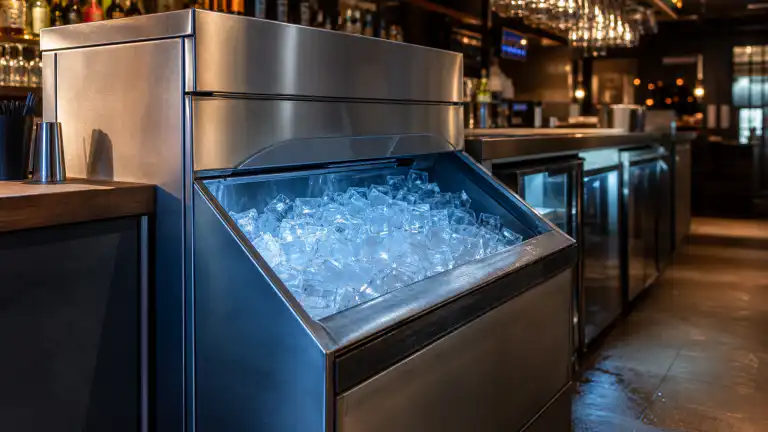
A reliable ice supply is a practical requirement for South African catering businesses serving beverages, displaying seafood, or operating bar service. Commercial ice machines produce ice continuously and store it ready for use, eliminating dependence on purchased bag ice and the operational disruption of running out during service.
Key selection criteria for South African operations:
- Production capacity per 24 hours matched to your peak daily ice consumption
- Ambient temperature rating, South African summer conditions reduce ice machine output; a machine rated for higher ambient temperatures is necessary in most South African locations
- Water quality consideration, hard water areas require machines with built-in water filtration to prevent scale build-up
Walk-In Cold Rooms
For large-scale operations, hotels, hospitals, large catering companies, and food production facilities, walk-in cold rooms provide the bulk cold storage capacity that individual upright units cannot match. Walk-in rooms allow forklift or pallet access, full stock organisation, and the scale of temperature-controlled environment needed for high-volume food service.
Walk-in cold room specification requires professional input on insulation panel thickness (matched to ambient temperature), refrigeration unit sizing, door type and sealing, and drainage configuration.
Refrigeration Capacity Planning
Incorrectly sized refrigeration is one of the most common and costly mistakes in commercial kitchen planning. Both under-sizing and over-sizing create problems:
| Scenario | Result |
|---|---|
| Under-sized refrigeration | Overcrowded units, poor airflow, temperature maintenance failure, food safety risk |
| Over-sized refrigeration | Unnecessary capital cost, higher energy use running a large unit at low capacity |
| Incorrect type for application | Display unit used for storage, or storage unit used at point of service, both create inefficiency |
| Poor ambient temperature rating | Unit struggles in South African summer, compressor overworks, early failure |
Capacity planning should be based on your maximum daily stock volume at peak trading, not average trading. Refrigeration must handle your busiest day without compromise.
Working With The Cater-Ring on Refrigeration
The Cater-Ring supplies commercial refrigeration equipment across South Africa, from undercounter units and upright freezers to blast chillers, ice machines, and display refrigerators. Our team provides practical guidance on selecting the right refrigeration configuration for your operation, taking into account your product range, production volume, kitchen layout, and South African ambient conditions.
Contact the team at +27 10 109 2104 or visit caterring.co.za/product-category/refrigeration-equipment/ to explore the full range.
Frequently Asked Questions
What temperature should a commercial refrigerator maintain in South Africa?
Commercial refrigerators must maintain food below 5°C to comply with South African food safety regulations. Freezers must maintain frozen products at -18°C or below. Units should be tested with a calibrated thermometer to verify they are maintaining these temperatures under actual operating conditions, not just at the thermostat setting.
How often should commercial refrigeration equipment be serviced in South Africa?
Commercial refrigeration equipment should be serviced at a minimum of once per year, with condenser coil cleaning every three to six months depending on the kitchen environment (dusty or high-humidity environments require more frequent cleaning). Door seals should be inspected monthly and replaced when they show any sign of deterioration.
What is the difference between a blast chiller and a standard refrigerator?
A standard refrigerator is designed to maintain already-cold food at safe temperatures. It is not designed to cool hot food, placing hot food in a standard fridge raises the interior temperature, puts other stored products at risk, and does not cool the food quickly enough to be safe. A blast chiller is specifically engineered to rapidly extract heat from hot food, reducing core temperature from above 60°C to below 5°C within 90 minutes.
Does The Cater-Ring supply refrigeration equipment for both small and large operations?
Yes. The Cater-Ring supplies refrigeration equipment suited to all scales of South African food service operation, from single undercounter units for small café kitchens to large-capacity upright freezers and blast chillers for high-volume catering and food production. Contact the team at +27 10 109 2104 to discuss your specific requirements.