Most food service operators in South Africa approach a new kitchen project the same way. They find a space, they decide what they want to sell, and then they start buying equipment. The result, more often than not, is a kitchen that works against them from day one. Poorly placed workstations, undersized refrigeration, inadequate ventilation, and equipment that fails compliance inspections are all predictable and preventable outcomes. A commercial kitchen consultant prevents them.
This guide explains what a commercial kitchen consultant actually does at each stage of a project, why the cost is almost always recovered in the first year of operation, and when you specifically need one.
What Is a Commercial Kitchen Consultant?
A commercial kitchen consultant is a specialist who advises food service businesses on the design, specification, procurement, and setup of their commercial kitchens. This is distinct from an interior designer or an architect. A consultant focuses on operational performance: how the kitchen will function under service pressure, how it will meet South African health and food safety regulations, and how the equipment specification will support the menu and volume requirements of the business.
In South Africa, the food service industry operates under a patchwork of regulatory requirements, including the Foodstuffs, Cosmetics and Disinfectants Act (Act 54 of 1972), municipal Certificate of Acceptability requirements, and sector-specific HACCP obligations. A qualified consultant understands these requirements and builds them into the project from the start, rather than having to retrofit compliance at significant cost.
The Six Stages Where a Consultant Adds Value
1. Needs Assessment
The first task of any consulting engagement is a structured needs assessment. This means understanding the business concept, the target menu, the projected covers or output volumes, the staffing model, and the site constraints. A consultant working on a restaurant will ask different questions than one working on a hotel kitchen or a bakery, because the operational demands are fundamentally different.
This stage is where many operators make their most expensive mistakes. Projecting too low results in a kitchen that cannot scale. Projecting too high results in capital tied up in equipment that never operates at capacity. An experienced consultant has worked across enough operations to calibrate these projections accurately.
2. Layout and Flow Design
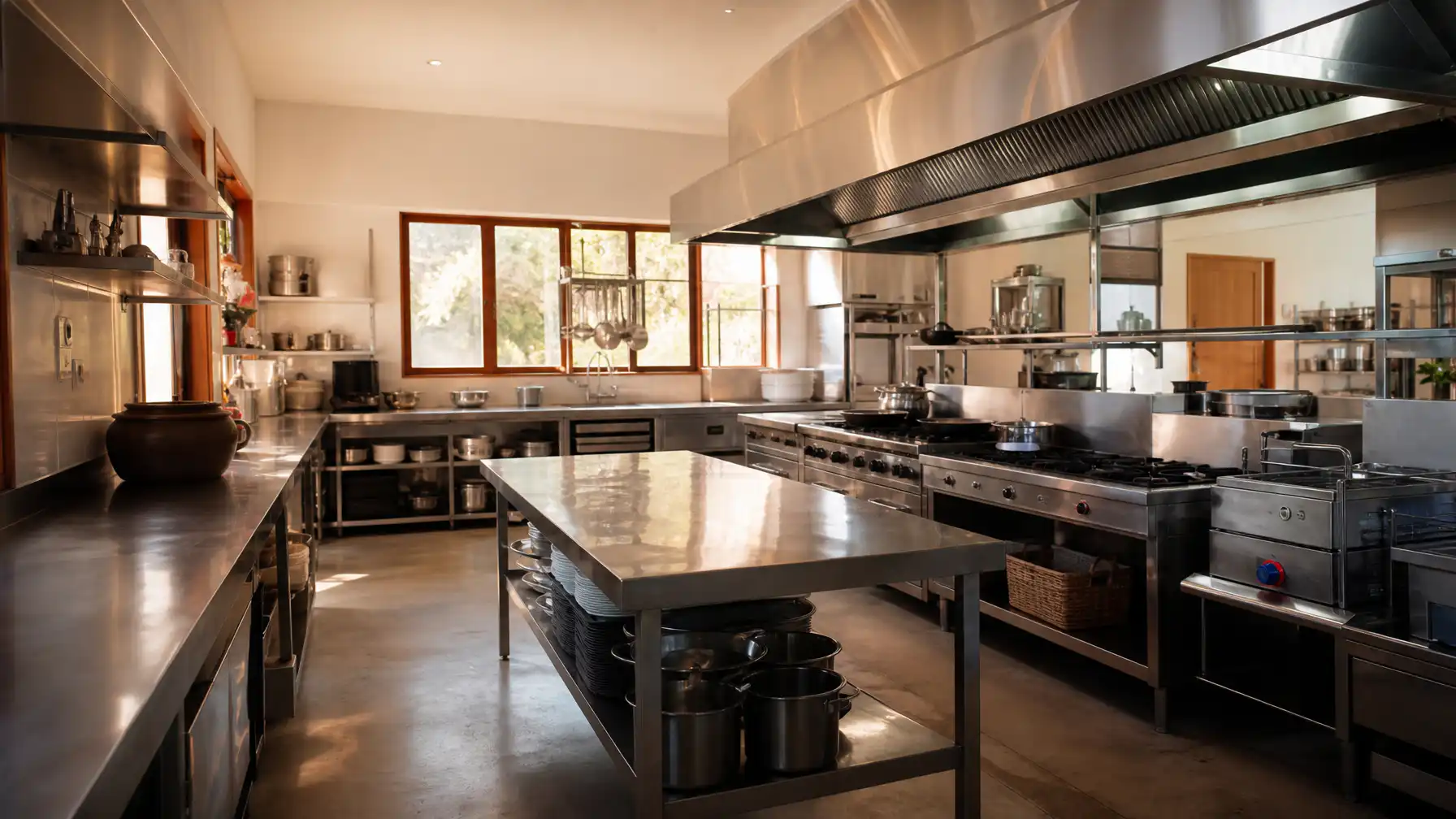
Kitchen layout directly determines labour efficiency. A well-designed kitchen reduces unnecessary movement, separates raw and cooked food handling zones to support HACCP compliance, and positions equipment so that service flows logically from prep through cooking to plating and pass. A poorly designed kitchen does the opposite, and the cost shows up in every service.
For South African operators, layout design must account for local constraints: load-shedding contingencies and gas versus electric trade-offs, water pressure and drainage requirements specific to municipal infrastructure, and the specific Certificate of Acceptability inspection criteria applied by local Environmental Health Practitioners (EHPs).
A consultant will produce scaled kitchen drawings and, on larger projects, 3D renders that allow stakeholders to visualise the space before a single piece of equipment is ordered.
3. Equipment Specification
This is often the stage where the most money is either saved or wasted. Equipment specification means selecting the exact models, capacities, and configurations of every piece of equipment in the kitchen, from the primary cooking equipment to the refrigeration units to the food preparation equipment and stainless steel work surfaces.
A consultant specifies equipment based on capacity requirements, not brand preference. They will advise on the trade-off between a deck oven and a convection oven for a bakery, or between a gas range and an induction cooktop for a restaurant with unreliable gas supply. They account for energy costs, service availability, and the practical realities of the South African supply chain.
4. Compliance Guidance
South African food service regulations are enforced at multiple levels. At the municipal level, every food handling premises requires a Certificate of Acceptability under the Regulations Governing General Hygiene Requirements for Food Premises (R638). At the sector level, high-risk operations such as commercial butcheries and large-scale food manufacturers must implement certified HACCP systems under SANS 10330.
A consultant guides the project through these requirements from the outset. This means specifying washable wall and floor finishes, ensuring adequate handwashing facilities at specified intervals throughout the kitchen, designing appropriate pest-exclusion measures, and ensuring the stainless steel sinks and drainage are positioned correctly for inspectors.
The cost of non-compliance is not just the fine. It is the shutdown, the refit, the resubmission, and the reputational damage. Getting it right the first time is measurably cheaper.
5. Procurement Support
A consultant who understands the South African catering equipment supply chain adds significant value in the procurement phase. They know which suppliers hold consistent stock, which brands carry reliable local service agreements, and where the lead times are likely to create problems for a project timeline.
This matters more than most clients anticipate. The Cater-Ring has operated in this supply chain for years, and we have seen what happens when procurement is left to chance. In one case, a client placed an urgent cross-border equipment order for a Zimbabwe operation. The original supplier committed to the full order but failed to deliver the final critical items at the last stage, putting the entire export and commissioning timeline at risk. The Cater-Ring was brought in, activated its supplier network, sourced replacement stock at short notice, absorbed the additional logistics costs to keep the client's timeline intact, and got the export away on a revised but workable schedule.
That outcome was only possible because of deep supply chain knowledge and supplier relationships built over years. A consultant with that kind of network pays for themselves in situations like this.
6. Training and Commissioning Support
The final stage of a consulting engagement typically involves equipment commissioning and staff training. This means ensuring that every piece of equipment is installed correctly, tested to specification, and that the staff who will use it understand proper operation and cleaning procedures. A kitchen that is set up correctly from day one operates more efficiently, has lower maintenance costs, and sustains compliance more reliably.
Is a Commercial Kitchen Consultant Worth the Cost?
The question most operators ask is whether the consulting fee is justified. In most cases, the answer is straightforward: the savings identified in the specification phase alone exceed the consulting fee. Specifying the right refrigeration capacity prevents the cost of a second unit purchased six months later. Catching a compliance issue in the design phase prevents the cost of a refit after the EHP inspection fails.
For larger projects, the return is more pronounced. A hotel with multiple service points, a large-scale butchery, or a production bakery all carry procurement costs high enough that even a small percentage saving on equipment specification exceeds a consulting fee many times over.
The Cater-Ring's consulting service is built around exactly this model: combining equipment supply with operational expertise to deliver kitchens that work from the first day of service.
Frequently Asked Questions
What qualifications should a commercial kitchen consultant have in South Africa?
Look for a consultant with demonstrable experience across multiple commercial kitchen projects, knowledge of South African food safety legislation (including the Foodstuffs, Cosmetics and Disinfectants Act and R638 regulations), and direct relationships with compliant equipment suppliers. Membership of industry bodies such as the Foodservice Consultants Society International (FCSI) is a useful indicator, but practical track record matters most.
At what stage of a project should I bring in a consultant?
The earlier, the better. The highest value a consultant delivers is in the needs assessment and layout design phases, before any procurement decisions are made. Bringing a consultant in after equipment has been ordered limits what can be changed and often results in a less optimal outcome.
Can a consultant help with load-shedding and power reliability issues?
Yes, and this is particularly important in the South African context. A competent consultant will assess the gas versus electric trade-off for each piece of equipment, advise on generator or UPS requirements for critical refrigeration, and specify equipment that performs reliably under the power conditions typical of the specific site and municipality.
Does The Cater-Ring offer consulting services for businesses outside South Africa?
Yes. The Cater-Ring supplies commercial catering equipment across Africa and has experience with cross-border procurement and export logistics. Our consulting service is available for projects across the region, with particular experience in SADC market operations.