A commercial dishwasher is not the most glamorous piece of equipment in a professional kitchen, but it is one of the most operationally critical. When it underperforms — or when you select the wrong type for your volume — the consequences run through your entire service: delayed tables, reused dirty ware, staff bottlenecks, and potential health code violations.
For South African food service operators, the selection decision carries additional complexity. Load-shedding, water restrictions, hard water in many inland regions, and the cost of electricity and chemicals under current tariffs all affect which machine makes financial sense for your operation.
This guide covers every factor that should inform your decision, from machine type to total cost of ownership.
Types of Commercial Dishwasher
The first decision is machine type, which is dictated by your throughput volume and the physical layout of your kitchen.
Undercounter Dishwashers
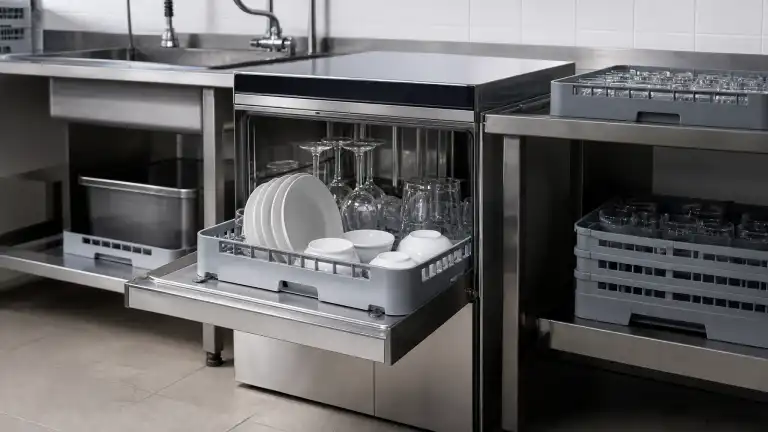
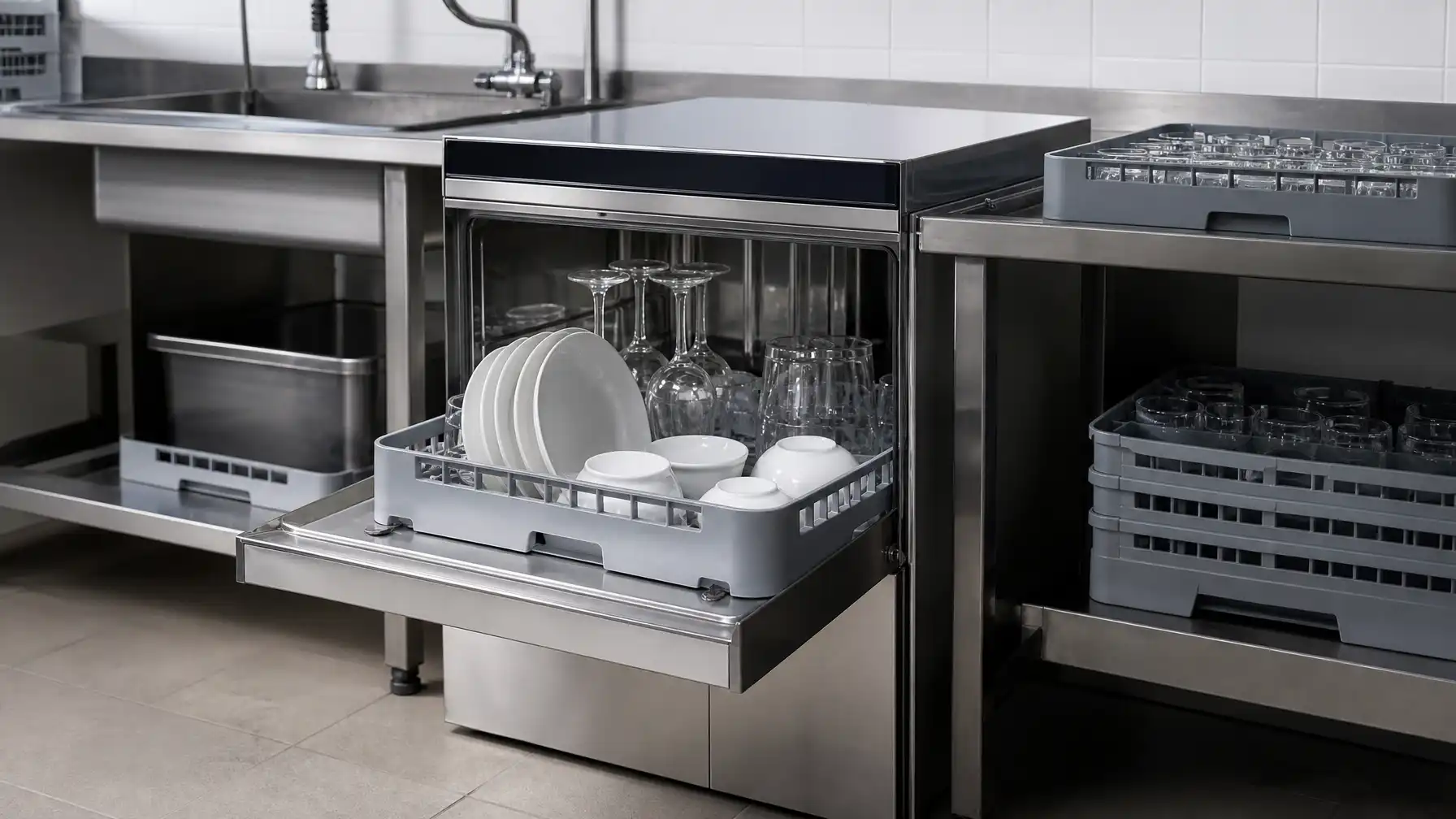
Undercounter machines are compact units designed to fit beneath a standard kitchen counter. They operate on a single rack per cycle, with typical cycle times of 90 to 180 seconds. Throughput capacity ranges from approximately 20 to 40 racks per hour, making them suitable for cafes, small restaurants, and bars with moderate cover counts (up to around 80 covers per service).
Their compact footprint is an advantage in small kitchens, but their limited capacity means they are not suitable for high-volume environments. In South Africa, where small restaurants and township eateries often have constrained back-of-house space, undercounter units are a practical and cost-effective entry point.
Hood/Pass-Through Dishwashers
Hood-type machines are door-type units where the operator lifts a door to load and unload a single rack. Cycle times are typically 60 to 120 seconds, and throughput capacity ranges from 40 to 80 racks per hour. They suit mid-sized restaurants, hotel restaurants, and catering operations serving 80 to 250 covers per service.
Pass-through configurations allow loading and unloading from opposite sides of the machine, which improves workflow in linear kitchen layouts.
Rack Conveyor Dishwashers
Conveyor machines transport racks through a series of wash, rinse, and sanitise zones automatically. Throughput is substantially higher — typically 150 to 250 racks per hour — making them the right choice for high-volume operations such as large hotel kitchens, conference centres, hospitals, and canteens serving more than 300 covers.
These machines require dedicated installation with sufficient plumbing capacity, drainage, and ventilation. Operating costs are higher, but labour costs are lower because operation is semi-automated.
Flight Conveyor Dishwashers
Flight conveyors are the highest-capacity option, used in institutional settings such as large hospitals, universities, and airlines. Wares travel on a continuous moving belt rather than individual racks. This equipment is less common in South African food service and is relevant only to very large institutional kitchens.
Matching Capacity to Your Operation
Selecting a machine with insufficient capacity is a common and costly mistake. To calculate the correct capacity, apply the following framework:
Calculate your peak demand in racks per hour:
- Determine your maximum covers per service (e.g., 120 covers).
- Estimate the number of items per cover (plates, glasses, cutlery, prep items). A typical restaurant cover produces 4–6 pieces.
- A standard rack holds approximately 25–36 plates or 25 glasses. Allow for mixed rack contents.
- Add preparation and cookware loads — these are often underestimated.
- Divide total item count by rack capacity to get racks per service, then factor in the service window (e.g., 90-minute peak) to get racks per hour.
As a rule of thumb: 80 covers typically requires 40 racks per hour capacity; 200 covers typically requires 80–100 racks per hour.
Always select a machine with 20–30% more capacity than your calculated requirement. This buffer accommodates broken cycles, staff efficiency variation, and growth.
Water Consumption and South African Context
Water is a significant operating cost in commercial dishwashing, and it is particularly relevant in South Africa given the country's water scarcity challenges and municipal restrictions across many regions.
A standard undercounter dishwasher uses approximately 2.5–4 litres per cycle. A hood-type machine uses 2–3 litres per rack. A conveyor machine uses more water in absolute terms but less per rack washed.
Modern commercial dishwashers with heat recovery and water recirculation systems substantially reduce water consumption per wash cycle. This matters for South African operators in two ways: it reduces water costs directly, and it positions the business better during water restriction periods in drought-affected municipalities (Cape Town's Day Zero crisis demonstrated how quickly water supply can become a operational constraint).
When comparing machines, request the water consumption figure per rack from the supplier, not the total machine consumption per cycle.
Energy Costs and Load-Shedding Considerations
South Africa's electricity tariffs have increased significantly in recent years, and Eskom's load-shedding schedule makes energy management an active operational challenge. This affects commercial dishwasher selection in two ways.
Kilowatt consumption per cycle directly impacts your monthly electricity costs. Higher-efficiency machines cost more upfront but return their premium through lower running costs. Calculate the break-even point using your current tariff (available from your municipality or Eskom for business accounts).
Heat recovery technology in premium commercial dishwashers captures exhaust heat from the drying phase and uses it to pre-heat incoming water. This reduces boiler energy consumption and is worth the additional capital cost in high-volume operations.
Load-shedding resilience is a practical South African consideration. If your generator does not carry the full load of a conveyor machine, confirm the machine's startup draw and running wattage against your backup power capacity before purchasing.
Our cooking equipment and kitchen setup team can assist with full power load calculations as part of a kitchen design consultation.
Chemical Dosing Systems
Commercial dishwashers use two chemical systems: detergent (wash phase) and rinse aid (final rinse phase). Both are delivered via automatic dosing pumps that meter the correct volume per cycle.
Detergent type should match your ware type. Glasswashers use low-pH detergents to protect glassware; heavy-duty pot washers use high-alkalinity detergents to break down grease and starch. General commercial dishwashers use intermediate-pH formulations.
Rinse aid reduces surface tension in the final rinse, accelerating water runoff and improving drying. Without it, plates dry slowly and carry water spots — a presentation issue for fine dining operations.
Dosing calibration matters for both cost control and wash quality. Over-dosing increases chemical costs and can leave residue on wares; under-dosing results in poor wash performance. Ask your supplier to calibrate the dosing pumps at installation and check them during routine servicing.
In South Africa, commercial dishwasher chemicals are available from catering supply companies and specialist chemical distributors nationwide.
Installation Requirements
A commercial dishwasher is a fixed installation with specific infrastructure requirements. Factor these into your planning before purchasing:
- Plumbing: Hot and cold water supply lines rated to the machine's connection specifications. Some machines are cold-water-fill only and heat water internally.
- Drainage: A floor drain with adequate capacity to handle rapid drain cycles. Conveyor machines drain continuously.
- Electrical: Three-phase power for most hood-type and conveyor machines. Undercounter units typically run on single-phase 220V supply.
- Ventilation: Commercial dishwashers generate significant steam. A dedicated exhaust canopy or built-in condenser is required to prevent steam damage to kitchen surfaces and maintain a safe working environment.
- Clearance: Allow sufficient space for door or hood operation, rack loading/unloading, and maintenance access.
Speak to a kitchen designer or our consulting services team before installation to avoid costly retrofits.
Descaling in South African Hard Water Conditions
Hard water — water with high calcium and magnesium content — causes limescale buildup on heating elements, spray arms, and internal surfaces. Limescale reduces heating efficiency, blocks spray arm jets, and shortens machine lifespan.
South Africa's inland regions — Johannesburg, Pretoria, and much of the highveld — have notably hard municipal water. Cape Town and coastal regions generally have softer water but still require monitoring.
Prevention is the most cost-effective approach:
- Install a water softener on the supply line if your water hardness exceeds 300mg/L (total dissolved solids).
- Use a liquid descaling agent in your weekly maintenance cycle.
- Inspect spray arms monthly and clear blocked jets.
- Service the heating element and boiler quarterly in hard water areas.
Ignoring descaling in hard water conditions leads to machine failure well before the expected service life. Factor descaling consumables and water softener maintenance into your total operating cost projection.
Total Cost of Ownership vs Purchase Price
Purchase price is a poor basis for commercial dishwasher selection. The correct metric is total cost of ownership (TCO) over the machine's expected service life (typically 7–12 years for a well-maintained commercial unit).
TCO components:
- Purchase price
- Installation costs (plumbing, electrical, ventilation)
- Water consumption cost per rack (annual)
- Energy consumption cost per rack (annual)
- Chemical cost per rack (annual)
- Servicing and maintenance (annual)
- Replacement parts over lifespan
- Labour cost (more relevant for manual-load vs conveyor machines)
A premium machine with lower running costs often delivers a lower TCO than a budget unit despite the higher upfront price. Run this calculation with your projected daily rack count and current utility tariffs before committing to a purchase.
The Cater-Ring supplies kitchen furniture and full commercial kitchen fit-outs, and our team can help you plan a dishwashing setup that fits your workflow and budget.
Frequently Asked Questions
What is the difference between a commercial dishwasher and a domestic dishwasher?
Commercial dishwashers operate on significantly shorter cycle times (90 seconds to 4 minutes versus 60–90 minutes for domestic units), use higher wash temperatures (60–85°C) to meet food safety sanitisation standards, and are built for continuous operation. They also use dedicated chemical dosing systems and require professional installation. A domestic dishwasher is not adequate for any food service environment and does not meet South African health code requirements for commercial food preparation.
How many racks per hour do I need for a 100-cover restaurant?
A 100-cover restaurant typically produces enough wares during peak service to require approximately 40–60 racks per hour of dishwasher capacity, depending on menu complexity and service duration. A hood-type dishwasher rated at 50–60 racks per hour is a practical fit for this volume. Add a 20–30% buffer to accommodate prep ware and cookware loads that are often underestimated in initial capacity calculations.
Do South African commercial kitchens need a specific type of commercial dishwasher?
There is no regulation specifying a particular dishwasher type in South Africa, but the Foodstuffs, Cosmetics and Disinfectants Act and the relevant municipal health bylaws require that wares used for food service are sanitised to a standard that eliminates harmful microorganisms. Commercial dishwashers meeting NSF/ANSI 3 or equivalent standards achieve this through temperature or chemical sanitisation. Your environmental health officer can advise on local requirements.
How often should a commercial dishwasher be serviced?
Most manufacturers recommend a full professional service every six months for high-volume operations, and annually for lighter use. In addition, operators should perform daily cleaning of the wash and rinse arms, weekly cleaning of the interior and drain filter, and monthly inspection of door seals and dosing pump calibration. Descaling frequency depends on local water hardness — monthly in hard water areas such as Johannesburg.